Basketball Challenge Games
Basketball Arcade Challenges Explained: Timed, Endless and Life-Limited
Three challenge formats, three different definitions of playing well — and how good games make difficulty rise without feeling unfair.
"Challenge mode" means very little on its own. Underneath the label there are three quite different formats, and each one defines playing well differently enough that a habit which helps in one actively hurts in another.
Format one: the timed round
A fixed clock, usually sixty seconds. Score whatever you can inside it.
What it rewards: pace. There is an optimal speed — not your maximum — at which score is maximised, and finding it is most of the skill.
How difficulty rises: usually by narrowing tolerances as the round progresses, or by raising the value of risky options so that the trade-off sharpens.
The distinctive trap: the post-miss spiral. A miss resets your multiplier, you rush to rebuild it, and the rushing produces two more misses. Timed rounds are far more often lost in the ten seconds after the first mistake than in the mistake itself.
Basketball Time Attack adds the sharpest version of this format: a combo that expires 3.6 seconds after your last make. Hesitation is not neutral there, it is scored against you.
Format two: the endless run
No clock, no finish line. The game accelerates until you fail.
What it rewards: survival. Because the score tracks duration, the safest viable route is usually also the highest-scoring one. This is the format where "play well" and "play carefully" coincide.
How difficulty rises: continuously — speed, spacing, target size — plus occasional step changes that introduce a new behaviour.
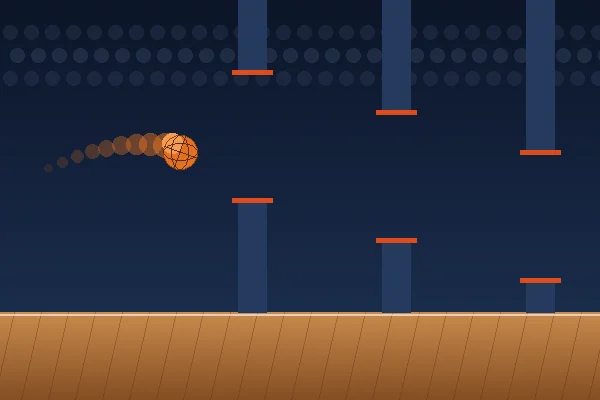
The distinctive trap: chasing bonuses late. Basketball Hoop Rush pays three points for a centred pass instead of one. Early, that is free. Late, the correction needed to centre yourself is a genuine risk, and two extra points are not worth ending a run that is producing one point every second anyway.
Format three: the life-limited run
No clock. A fixed number of failures ends it.
What it rewards: patience — and this is the format most players play worst, because they import habits from timed games.
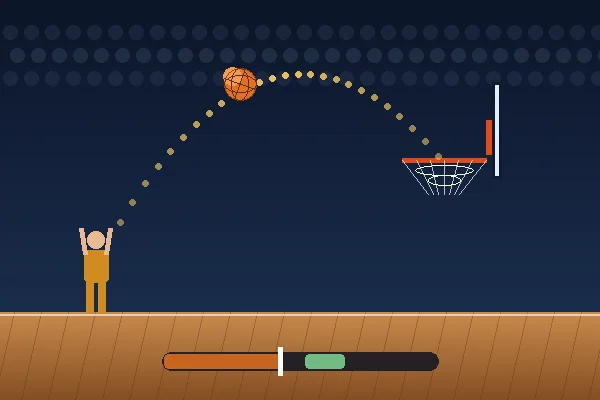
The key property: waiting costs nothing. In Basketball Precision Shot the hoop drifts on a sine path, which means it is briefly almost stationary at the top and bottom of its travel. Those moments are dramatically easier than any other, and there is no clock charging you for waiting.
Most players shoot on a rhythm anyway, and spend their five lives on shots they never had to take.
The distinctive trap: treating the last life like the first. Once you are one failure from the end, the expected value of a risky attempt collapses, because everything you would score afterwards disappears with the run.
Comparing them
| Timed | Endless | Life-limited | |
|---|---|---|---|
| Ends when | Clock hits zero | You fail | Lives run out |
| Score measures | Output per minute | Duration survived | Quality over a run |
| Waiting costs | A lot | Nothing | Nothing |
| Correct late-run play | Take value shots | Get safer | Get much safer |
| Punishes | Poor pacing | Lapses of attention | Impatience |
How difficulty should rise
Every challenge format needs an escalation, and there is a right way and a wrong way to build one.
Visible escalation. The rim moves further out and you see it move. The meter speeds up and you see it speed up. The take-off band narrows and you see it narrow.
Invisible escalation. The tolerance quietly shrinks with no on-screen change. Mathematically identical; experientially completely different. Invisible difficulty produces the same feeling as a game that cheats, because the player has no way to distinguish the two.
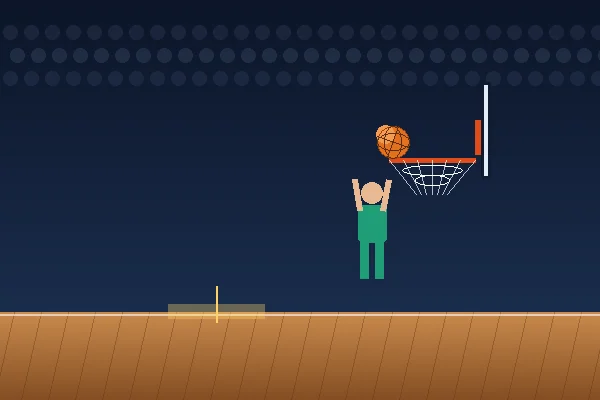
Every game on this site escalates visibly. The bands drawn on screen in Time Attack and Dunk Challenge are the tolerances — when they narrow, you watch them narrow.
One variable at a time is the other half of the rule. Raising speed and shrinking the target simultaneously produces a difficulty cliff, and a cliff feels arbitrary even when it is deterministic.
Rubber-banding, and why score games should avoid it
Rubber-banding is a hidden system that helps a struggling player or hinders a dominant one. In a racing game it keeps a race close, which is often the right call.
In a score-attack game it is corrosive, because the score is the entire product. If the game quietly widened your window after two misses, your best score would no longer mean what it appears to mean — and once players suspect that, every score becomes suspect.
The games here do not adjust difficulty based on how you are doing. Difficulty rises on a schedule tied to your progress (rounds cleared, streak length, hoops passed) and nothing else. Two players reaching round eight face identical conditions.
Making a run end well
A good challenge game makes the end feel earned. That requires three things:
A legible cause. You should be able to name what ended the run in one sentence: "I jumped late", "I clipped the top rim", "the clock ran out with a shot in the air".
A number you understand. The game-over screen should show what you scored, what your best is, and whether you beat it. All three games shapes here do.
An immediate restart. Anything between the end of one run and the start of the next is friction in a genre built on short loops. One press.
What a fair escalation looks like
Every challenge format needs to get harder. The difference between escalation that feels earned and escalation that feels arbitrary comes down to four properties.
It is visible. The player can see what changed. A rim that shrinks should visibly shrink; a meter that speeds up should visibly speed up.
It changes one thing at a time. Raising speed and tightening tolerance together produces a difficulty cliff, and a cliff reads as unfair even when it is perfectly deterministic. Where games do change two at once — Dunk Challenge raises speed and narrows the window each round — the steps need to be small enough that the combined effect stays gradual.
It is tied to success, not to time. Difficulty that rises on a clock punishes a struggling player twice: they are failing at the current level and being moved past it. Difficulty tied to progress meets each player where they are.
It is announced, or at least telegraphed. Basketball Hoop Rush introduces drifting hoops at a fixed point rather than gradually, which sounds harsher and is actually kinder — a step change you can learn to expect beats a continuous change you cannot perceive.
What a good game-over screen does
The moment a run ends is more important than it looks, because it is where a player decides whether to press again.
Three numbers, no more. This round's score, your best, and whether you beat it. Anything else is noise at the exact moment attention is lowest.
A one-sentence cause. "Time!", "You clipped a rim", "Five misses". The player should never have to reconstruct what happened.
Restart on the same key that was already in your hand. In every game here, Space restarts — because Space is what you were already pressing.
No delay. Any forced pause between the end of one run and the start of the next is friction in a genre built on immediate retries.
Nothing to dismiss first. No interstitial, no "are you sure", nothing that must be closed before the button you want.
Games here do all five. It is not a high bar and it is regularly missed.
The comeback problem
Every challenge format has to decide what happens when a run goes badly early, and the honest options are limited.
Do nothing. The run is worse; the player finishes it or restarts. Simple, honest, and it makes early mistakes feel disproportionately costly in a sixty-second game.
Make recovery possible by design. Multipliers that rebuild quickly mean a bad first fifteen seconds is genuinely recoverable. This is the approach here: in Basketball Time Attack, two consecutive makes put you back on a multiplier, so nothing is ever over at the thirty-second mark.
Rubber-band. Quietly help the struggling player. Makes runs feel closer and makes every score meaningless, which is why score-attack games should not do it.
The middle option is the only one that solves the problem without lying, and it is a design decision made long before the player arrives: keep the ramp-up to full multiplier short enough that recovery is real.
Formats we have not built
For completeness, three challenge shapes the site does not currently have.
Round-based with escalating conditions. Survive a round, face a modified version, repeat. Longer arc than sixty seconds, with the structure that a score-attack lacks.
Objective-based. "Make five in a row from deep." Different from a score because it is pass or fail, which changes how risk feels.
Daily fixed challenge. The same conditions for everyone on a given day. Works well with a leaderboard, which we do not have, and would be thin without one.
Which format suits you
If you find timed formats stressful, that usually means pacing rather than execution — and pacing is learnable. Try a life-limited game first, where the pressure comes from the cost of a mistake rather than from the clock.
If you find endless formats boring, you probably prefer discrete decisions to continuous ones. Timed shooting games will suit you better.
If you find life-limited formats frustrating, check whether you are waiting for good opportunities at all. Most people who dislike them are playing them like timed games.
The full strategic treatment is in high score strategies for every game type.
Frequently asked questions
What is a challenge game in the arcade genre?
Any game where a constraint — a clock, a life count, or an accelerating run — defines the end of a session, and the score measures what you achieved inside it.
Which challenge format is hardest?
They are hard in different ways. Timed formats punish poor pacing, endless formats punish lapses of attention, and life-limited formats punish impatience. Most players find one much harder than the others, and it usually reflects a habit rather than a skill gap.
How should difficulty rise in a fair challenge game?
Visibly, and one variable at a time. If the rim shrinks, you should see it shrink. Difficulty that rises invisibly reads as the game cheating, even when it is scrupulously fair.
What is rubber-banding?
A hidden system that quietly helps a player who is losing or hinders one who is winning. It makes a game feel closer but makes its scores meaningless, which is why score-attack games should avoid it.