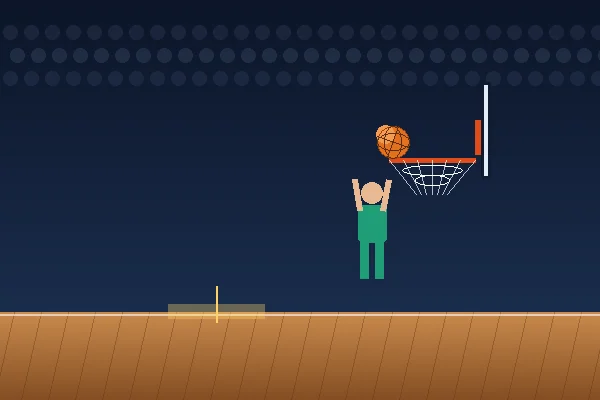
 Featured
Dunk Challenge
Time the take-off, finish at the rim, and use the brake and sprint controls to put yourself in the window.
One button + run control
Category
Dunk games trade distance for timing. The rim is right there — the whole game is leaving the floor at exactly the right moment.
Every game in this category, playable instantly in your browser.
Featured
Time the take-off, finish at the rim, and use the brake and sprint controls to put yourself in the window.
A shooting game asks how well you judge space. A dunk game asks how well you judge time. You are already close to the rim; the difficulty is that your jump is a fixed arc, and you get to choose exactly one thing about it — when it starts.
That constraint is what makes the genre work. A jump that begins a fraction early peaks before you arrive and you come down onto the rim. A fraction late and you are still rising when you reach it. Neither feels unfair, because both are readable: you can watch the mistake happen.
The first is reading the take-off marker rather than the rim. Almost everyone new to dunk games watches the hoop and jumps when it feels close. The take-off zone drawn on the floor is the actual target, and learning to trust it is worth more than any other single habit.
The second is speed control. In Dunk Challenge you can brake or sprint during the run-up, which moves where the zone sits and how wide it is. Sprinting widens the window in distance but gives you less time to react to it. Braking does the opposite. Choosing deliberately between those is the difference between clearing five rounds and clearing fifteen.
Dunk timing transfers directly to other timing-led games. If you enjoy this category, the endless-runner rhythm of Basketball Hoop Rush uses the same instinct on a shorter loop.
Written while the games were open, and tested against them.

Reading the take-off band, choosing between brake and sprint, and the layup decision that keeps combos alive.
Why almost everyone releases late, what a timing window actually is, and how to train anticipation instead of reaction.
What separates a satisfying dunk game from a frustrating one — and the one habit that doubles most players’ scores.
One button, drag-to-aim, hold-and-release — why the scheme a game chooses changes what it is really testing.
Watch the take-off marker on the floor rather than the rim. The jump is a fixed arc, so the only variable is where you leave the ground — pressing when your player reaches the middle of the highlighted band puts the top of the jump at the rim.
"Too late" means you were still rising when you reached the rim, which happens when you take off past the marked band. Braking slightly during the run-up gives you more reaction time, at the cost of a narrower window.
Yes. Dunk Challenge shows large on-screen buttons on touch devices, and you can also tap anywhere on the court to jump.
In Dunk Challenge, yes. Each cleared round raises the run speed and narrows the timing tolerance. Three misses ends the run.