Basketball Dunk Games
Basketball Dunk Game Tips: Timing, Take-Off and Combos
Reading the take-off band, choosing between brake and sprint, and the layup decision that keeps combos alive.

Dunk games look like they are about the rim. They are about the floor.
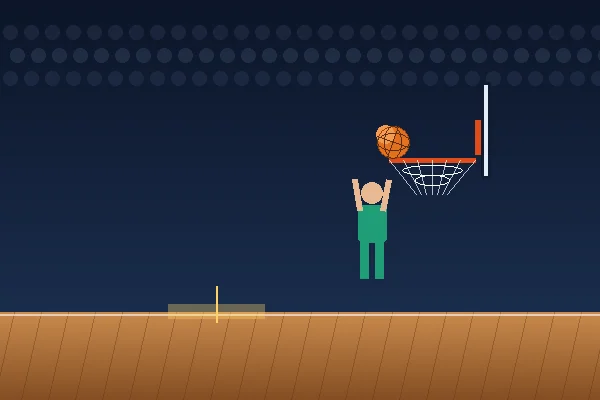
Everything below refers to Dunk Challenge, where your player runs at the hoop automatically, the jump is a fixed arc, and the only decision is when it starts.
The band on the floor is the target
The highlighted band drawn on the court is not decoration. It is calculated from the jump's flight maths: take off inside it and the top of your jump lands at the rim.
This is worth stating plainly because the instinct is to watch the hoop and jump when it feels close. That instinct fails for a specific reason — the rim is in a fixed place, but the correct take-off point moves depending on how fast you are running. Your feel is calibrated to one speed, and the game changes speed every round.
Watch the band. Press when your player's feet reach the middle of it.
Read the failure message
When you miss, the game tells you which way you were wrong, and the two answers have opposite fixes.
"Too early" — you left the floor before the band. Your jump peaked before you reached the rim and you were already descending on arrival. Take off later.
"Too late" — you left the floor after the band. You were still rising when you got there. Take off earlier.
"No jump" — you ran past the rim entirely.
Most players get one of these far more often than the other. That is good news: it makes the fix a single directional adjustment rather than a general skill deficit. Note which message you get most in a round and correct only that.
Brake and sprint are a real decision
Holding left brakes to about two thirds of the base speed; holding right sprints to about a third faster. These do two things at once, and the trade-off is the interesting part of the game.
Sprinting covers more floor per unit of time. Because the timing tolerance is fixed in time, covering more ground makes the band physically wider — but you have less time to react to it.
Braking narrows the band in distance but slows the whole approach, giving you more time to judge.
Which is right depends on what is going wrong:
- Errors scattered on both sides? You need time. Brake.
- Errors consistently on one side? You need a bigger target while you recalibrate. Sprint, and
move your trigger point in the direction the messages indicate.
- Clearing rounds comfortably? Sprint. You will reach higher rounds faster, and the band is
wider while you do it.
Take the layup when you are unsure
A dunk pays ten points. A layup pays four. Both keep the combo alive.
This matters more than the raw numbers suggest, because the combo multiplier rises every three consecutive finishes and caps at x4. A layup at x3 is worth twelve points and keeps the chain intact. A missed dunk is worth zero, resets the multiplier, and costs a life.
The practical rule: if you are not confident you are in the band, aim to be safely inside the wider layup window rather than gambling on the narrow one. The layup window is roughly two and a half times as wide, which is a lot of forgiveness for a 60 per cent pay cut.
Recalibrate at the start of each round
Each cleared round raises the run speed and narrows the timing tolerance. Two changes at once, both in the direction of harder.
Treat the first attempt of every new round as a calibration attempt. Watch the band's new position before committing. Players who carry round four's rhythm into round five tend to lose a life immediately, and then a second one to the overcorrection.
Three misses, and what to do with the second one
The run ends on the third miss. That means the second miss should change how you play.
After the second miss, brake. You will score more slowly, but the objective has shifted from maximising points per round to not ending the run. A conservative round five that you survive is worth far more than an aggressive one that ends there, because everything you score afterwards is multiplied by a combo you would not otherwise have.
Finding your bias in a single round
Almost every player has a consistent directional bias, and almost nobody knows which way it goes until they check.
Play one round of Dunk Challenge without using brake or sprint at all, and note the failure message on every miss. Three misses is enough data.
- Three "too late" — you are reacting rather than anticipating. Move your trigger point clearly
earlier, by about half the width of the band.
- Three "too early" — less common, usually from over-correcting a previous session. Move later.
- A mix — you need more time, not a different trigger. Brake.
The reason this works is that the correction for a consistent bias is a single adjustment, while the correction for scatter is a change of approach. Treating one as the other is the most common way players get stuck.
What to expect round by round
Knowing the shape of the difficulty curve stops early rounds feeling easy and later ones feeling arbitrary.
| Rounds | Run speed | Dunk window | What it feels like |
|---|---|---|---|
| 1–3 | Slow | Generous | Learning where the band is |
| 4–7 | Moderate | Noticeably tighter | The game starts asking real questions |
| 8–12 | Fast | Tight | Layup decisions start mattering |
| 13+ | Near cap | Minimum | Every attempt is a genuine commitment |
The speed rises by a fixed amount each round to a cap, and the dunk tolerance tightens each round to a floor. Because both change together, the difficulty step between round seven and round eight feels larger than the one between three and four even though the arithmetic is linear.
Most players' first wall is somewhere around round six. The second is around round eleven, and it is usually the layup decision rather than the timing that gets them past it.
When the band looks wrong
Two situations where the take-off band appears to be in a strange place, and both are working as intended.
It moves while you hold sprint or brake. Correct. The band's position is derived from your current speed, because the correct take-off point is further from the rim the faster you are travelling. Watching it slide as you change speed is the clearest way to understand the mechanic.
It looks narrower than the last round. Also correct. The tolerance tightens every round. If you are missing in a way that felt fine a round ago, the game changed rather than you.
What is not intended: a band that appears after you have already passed it. If that happens, it is a rendering issue rather than a game rule, and it is worth reporting with your browser and device.
The layup decision, in numbers
Everyone knows they should sometimes take the layup. Here is when.
A dunk is worth 10 points, a layup 4. Both keep the combo. The layup window is about 2.4 times wider.
So if your chance of hitting the dunk window is p, your chance of hitting the layup window is meaningfully higher — call it q, where q is close to 1 whenever p is even moderate.
Going for the dunk is worth 10p plus the value of a surviving combo times p. Going for the layup is worth 4q plus the combo value times q. Because a miss costs a life and the multiplier, the combo term dominates as your multiplier climbs.
The rule of thumb that falls out: once your multiplier is x3 or higher, take the layup whenever you are not confident. Below x2, the dunk is usually worth it.
A short practice routine
- Five deliberate-early runs. Jump clearly before the band on purpose. It sounds silly; it
recalibrates a sense that is almost always biased late.
- Five brake-only runs. No sprinting at all. Find the timing at slow speed first.
- Five normal runs. Note which failure message dominates.
- Correct one thing and repeat.
If you want the general principles underneath this — reaction latency, anticipation, why almost everyone releases late — they are in how to master timing in basketball arcade games.
Frequently asked questions
How do I stop missing dunks?
Read the message the game gives you. "Too early" means you jumped before the band and peaked short of the rim — take off later. "Too late" means you were still rising on arrival — take off earlier. Most players get one of these consistently, which makes it a single correction rather than a skill problem.
Is it better to sprint or brake in a dunk game?
It depends on your error pattern. Sprinting widens the take-off band in distance but leaves less time to react; braking narrows it but slows the whole approach down. If your misses are scattered on both sides, brake. If they are consistently on one side, sprint and shift your trigger point.
What is the difference between a dunk and a layup in these games?
A dunk requires the tighter timing window and pays ten points; a layup is the wider window and pays four. Both keep your combo alive, which is why taking the layup is often the better play when you are unsure.