Basketball Skill Games
How to Master Timing in Basketball Arcade Games
Why almost everyone releases late, what a timing window actually is, and how to train anticipation instead of reaction.
Timing games have a reputation for being unfair. They are usually not. What they are is precise, and precision exposes a gap most players do not know they have: the difference between reacting to something and anticipating it.
Close that gap and timing games stop feeling random.
The 200-millisecond problem
Seeing something, deciding to act, and getting a finger to move takes most people somewhere around a fifth of a second. That figure varies with age, fatigue and how expected the event is, but the order of magnitude is stable.
Now consider what that means for a meter sweeping across a bar in about a second. By the time you have seen the needle enter the window and told your finger to move, the needle has travelled roughly a fifth of the way across the bar. If the window is narrower than that, reacting to it is physically impossible.
This is not a skill problem. It is a latency problem, and there is only one solution: stop reacting.
Anticipation, in practice
Anticipation means choosing your release point before the cue arrives, then executing on schedule regardless of what you see in the final moment.
Concretely:
- Pick a trigger earlier than the target. If the window is in the middle of the bar, decide to
press when the needle reaches the quarter mark. Your input lands in the middle.
- Commit. The most common failure is starting the movement, doubting it, and delaying — which
converts a small error into a large one.
- Adjust the trigger, not the effort. If you are landing late, move the trigger earlier next
time. Do not try to "be faster"; you have already established that you cannot be.
Reading a meter that moves at constant speed
A constant-speed meter is the friendliest thing in the genre, because it is countable.
The power meter in the 3-Point Basketball Challenge sweeps back and forth at a fixed rate within each lap. That predictability means you can build a rhythm: watch one full sweep without shooting, feel the beat, and release on the next pass. Players who do this consistently outscore players who stare at the needle, because a rhythm is something your body can execute without a reaction step in the middle.
The catch, and it is a deliberate one: the meter speeds up each time you complete all five racks. A rhythm learned in lap one is wrong in lap two. Expect it, and spend the first shot of each new lap recalibrating rather than scoring.
Reading a target that moves
Moving targets are a different skill: you are not timing an input against a meter, you are leading a target in space.
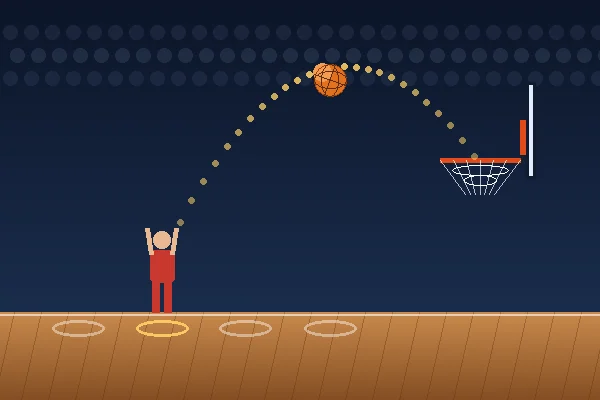
Basketball Precision Shot is the clean example. The hoop drifts up and down, and the ball takes real time to travel. Release when the arc points at the hoop and you will miss behind it, because the hoop has moved on by the time the ball arrives.
Two things make this manageable:
Aim where it is going. Release when the arc points slightly ahead of the hoop's current position, in its direction of travel. How far ahead depends on flight time, which you learn in a few shots.
Shoot at the turning points. A hoop moving on a sine path is briefly almost stationary at the top and bottom of its travel. Those two moments are the most forgiving in the entire game, and waiting for them costs nothing but a second — there is no clock in that game, only a five-miss limit.
That second point is the single highest-value tactic in the game and almost nobody finds it unprompted.
Timing a fixed jump
Dunk Challenge is timing in its purest form: the jump is a fixed arc, so the only thing you control is where it starts.
Two details make it more tractable than it looks:
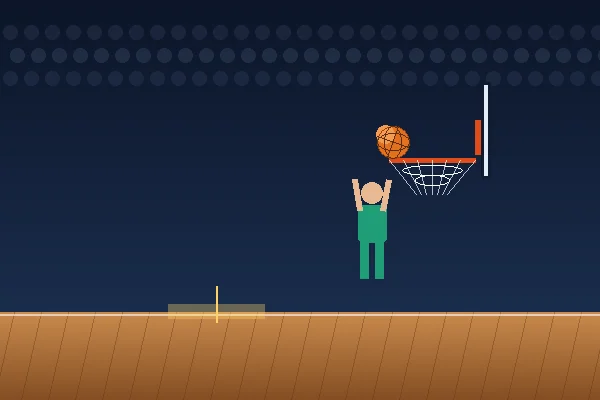
The band on the floor is the real window. It is calculated from the flight maths, not drawn for decoration. If your take-off is inside it, the jump peaks at the rim.
Speed changes the trade-off. Sprinting widens the band in distance — you cover more ground per unit of time, so the same time tolerance spans more floor — but gives you less time to react to it. Braking narrows the band but slows everything down.
Which to choose depends on the error you are making. If you are missing in both directions, brake: you need more time. If you are consistently missing on one side, sprint and move your trigger — you have a calibration problem, not a reaction one.
Rhythm beats precision
The counterintuitive finding, if you play enough of these: players who develop a rhythm beat players who aim for precision on every individual input.
The reason is that rhythm bypasses the decision step. A steady pattern — release, reset, release, reset — runs on a timing loop your body maintains, rather than on a series of independent judgements each carrying its own latency and doubt.
This is also why timed games punish hesitation twice: once on the clock, and once by breaking the rhythm that was making you accurate.
Fatigue is the first thing to go
Timing degrades faster than any other arcade skill, and it degrades in a specific direction: you start landing late.
That makes lateness a useful diagnostic. If your release points were fine twenty minutes ago and you are now consistently trailing the window, nothing about your technique has changed — you are tired. The correct response is to stop, not to concentrate harder, because concentrating harder is exactly what produces the doubt-then-delay failure described above.
The latency you can control, and the latency you cannot
Between something happening on screen and the game registering your response, several delays stack up. Knowing which are yours to fix stops you blaming the wrong one.
Cannot be changed: your own reaction time, roughly 200 milliseconds to a visual cue. This is the big one, and the reason anticipation beats reaction.
Can be reduced:
- Frame rate. A game running at 30fps instead of 60 shows you the meter half as often, which
doubles the granularity of your visual information. Battery saver mode is the usual cause on a phone; a dozen heavy tabs is the usual cause on a laptop.
- Background load. Browsers share one rendering budget across tabs. Closing what you are not
using is the single most effective performance change available to most people.
- Thermal throttling. A hot device slows down. If your timing was fine an hour ago and is not
now, check this before concluding you have got worse.
Barely matters: display refresh rate beyond 60Hz. Going from 60Hz to 120Hz saves about four milliseconds of display latency — real, but small next to 200 milliseconds of human latency. Consistent frame pacing matters far more than peak refresh rate.
Calibrating to a new game in sixty seconds
A routine for any timing game you have not played before, including ones not on this site.
Ten seconds: watch, do not play. Let the meter sweep or the target move without pressing anything. You are establishing the period — how long one full cycle takes.
Ten seconds: press deliberately early. Aim visibly before the target. You will fail, and the failure tells you how far early is too early, which is information you cannot get by aiming correctly.
Ten seconds: press deliberately late. Same, from the other side. Now you have bracketed the window.
Thirty seconds: aim at the middle of the bracket and adjust from there.
This takes less time than three failed attempts at getting it right by feel, and it produces a calibration rather than a guess. It is also the fastest way to adapt when a game changes speed on you mid-session, which happens on every lap in the 3-Point Challenge and every round in Dunk Challenge.
Why timing feels different on different days
It genuinely does, and the reasons are mostly mundane rather than mysterious.
Time since waking. Reaction time is measurably worse in the first hour or so after waking and in the last hour before sleep.
Caffeine, and its absence. Both the presence and the withdrawal shift reaction time, usually in opposite directions.
Screen and input distance. Playing on a phone held at arm's length versus close to your face changes how large the moving element appears, which changes how early you perceive it.
Which game you played last. Timing calibration is sticky. Coming to Dunk Challenge straight from Hoop Rush carries the wrong rhythm across, and the first round usually suffers.
None of these is worth optimising. They are worth recognising, so that a bad session reads as a bad session rather than as evidence you have plateaued.
The specific trap of games that speed up
Several games here raise their speed as you succeed, which creates a failure mode that catches almost everyone: you get worse immediately after doing well.
This is not a coincidence and it is not the game being unfair. Clearing a lap in the 3-Point Challenge speeds the meter up. Clearing a round in Dunk Challenge raises your run speed and narrows the window. In both cases the rhythm that earned the progression is now wrong.
The fix is a habit rather than a skill: treat the first attempt after any progression as a calibration attempt. Expect to lose it. Players who expect to score on it usually lose two — the attempt itself, and the overcorrection that follows.
Drills that build anticipation
The silent sweep. Watch three full meter cycles in the 3-Point Challenge without pressing anything. Then shoot. You are installing the rhythm before you use it.
Turning points only. In Precision Shot, take ten shots releasing only when the hoop is at the top or bottom of its travel. It teaches patience and it teaches you what an easy shot looks like.
Deliberate early. Play one round of Dunk Challenge trying to take off clearly too early. You will get "too early" messages, which is the point: it recalibrates your sense of where the band actually is, because most players' internal estimate is biased late.
One variable. Whatever game you are in, spend a round changing exactly one thing. Timing improvements are invisible in noisy data, and playing normally is very noisy data.
Frequently asked questions
Why am I always slightly late in timing games?
Because you are reacting rather than anticipating. Seeing a cue, deciding, and moving a finger takes roughly 200 milliseconds, which is longer than many arcade timing windows. The fix is to choose your release point in advance and commit to it before the cue arrives.
How wide is a typical timing window?
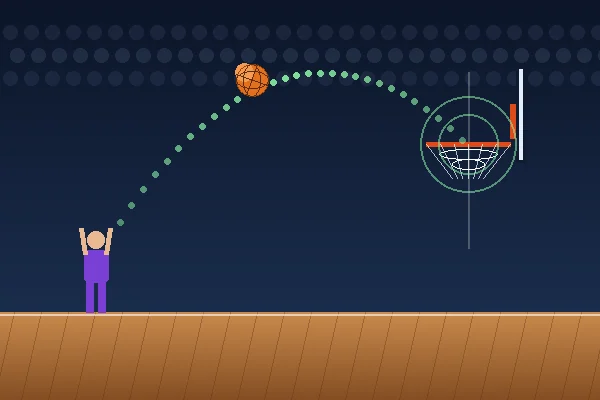
It varies a lot by game and difficulty. On this site the windows are drawn on screen rather than hidden — the green band in Basketball Time Attack and the take-off band in Dunk Challenge are the real tolerances, not decoration — and they narrow as your combo or round count rises.
Does a higher refresh-rate screen help?
Marginally. A 120Hz display shows a moving meter roughly 4 milliseconds sooner than a 60Hz one, which is small next to a 200ms reaction time. Consistent frame pacing matters more than raw refresh rate, so closing heavy background tabs helps more than new hardware.
Can I practise timing without playing?
Not usefully. Timing is calibrated to a specific game’s speed and animation, so it has to be built inside that game. The transferable part is the habit of anticipating rather than reacting.
References
External sources used in this article. Game mechanics described above come from the games’ own rules, which are documented on each game page.
- Reaction time — Encyclopaedia Britannica — General background on simple visual reaction time in humans.
- requestAnimationFrame — MDN Web Docs — How browser games synchronise animation with the display refresh.