Basketball Arcade Guides
Basketball Arcade Terminology: A Plain-English Glossary
Arc, combo, window, multiplier, swish bonus — what the vocabulary of arcade basketball games actually means.
Arcade basketball borrows half its vocabulary from basketball and half from game design, and the two halves behave differently. Basketball words usually mean what you expect. Game-design words often do not.
None of this is standardised between games, which is why every game page on this site spells out its own numbers.
Terms about the shot
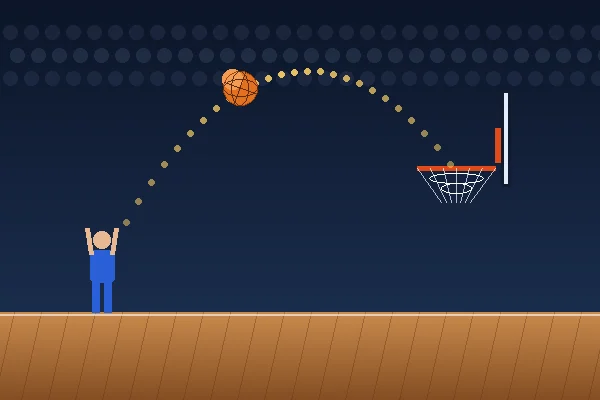
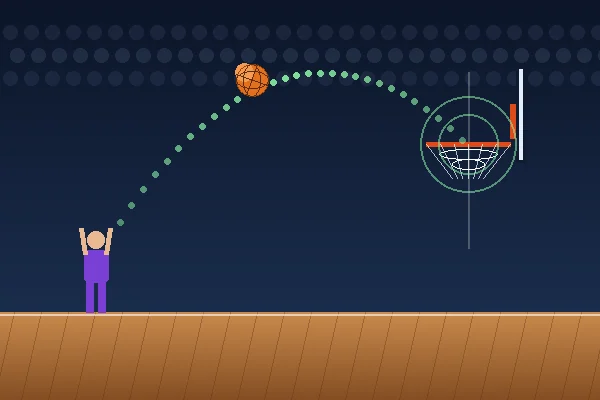
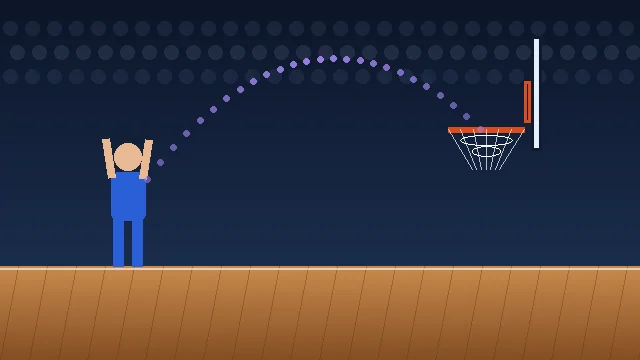
Arc — the curve the ball travels along. A high or steep arc falls into the hoop from above; a flat arc arrives nearly horizontally. Steeper arcs are more forgiving because the ball is dropping into a wider effective opening. This is the single most useful concept in the genre — there is a longer explanation in how to improve your arcade shooting accuracy.
Release angle — the angle at which the ball leaves the shooter. Some games let you set it (Basketball Shooting Challenge), some sweep it automatically (Precision Shot), and some fix it so that power is the only variable (the 3-Point Challenge, at 56 degrees; Time Attack, at 58).
Power — how fast the ball leaves the shooter. Usually set by a meter, a charge, or the length of a drag.
Bank shot — a shot that goes in off the backboard. Only meaningful in games where the backboard is a real collision surface, which it is on this site.
Swish — through the net without touching the rim. Often carries a small bonus.
Leading the target — releasing ahead of where a moving hoop currently is, so the ball and the hoop arrive at the same place at the same time.
Terms about scoring
Base value — what an action is worth before any bonus. Usually two points for a close basket, three from distance.
Combo — a run of consecutive successes. What breaks a combo differs by game: a miss always does, and in Basketball Time Attack a combo also expires after 3.6 seconds without a make.
Multiplier — a number the base value is multiplied by, driven by the combo. On this site multipliers cap at x4 or x5 depending on the game. Multipliers are usually the largest single factor in a high score.
Streak bonus — an additional flat bonus for a long run, separate from the multiplier. The 3-Point Challenge adds one point per make once you are three makes into a streak.
Money ball — a specific shot worth more than the others. In the 3-Point Challenge it is the last ball of each five-ball rack.
Accuracy grade — scoring based on how well you succeeded, not merely whether you did. Basketball Precision Shot grades every make as Perfect, Great or Good based on how centrally the ball passed through the rim.
Clean pass — in Basketball Hoop Rush, going through the middle of a hoop rather than near its edge. Worth three points rather than one.
Terms about difficulty
Timing window — the span of time in which an input counts as correct. Narrower windows are harder. On this site the windows are drawn on screen rather than hidden.
Tolerance — the same idea expressed as "how wrong can I be and still succeed". Often expressed in distance rather than time.
Tier — a difficulty step. Basketball Shooting Challenge moves the rim further out in tiers as your streak grows.
Lap — a completed cycle through all content. In the 3-Point Challenge, finishing all five racks completes a lap, which speeds the meter and narrows the rim.
Ramp — how quickly difficulty rises. A gentle ramp gives you many rounds before things get hard; a steep ramp gets there quickly.
Life / miss limit — a fixed number of failures before the run ends. Dunk Challenge allows three; Precision Shot allows five.
Terms about game structure
Endless — no finish line. The game accelerates until you fail, and the score measures survival.
Time attack — a fixed clock, and a score measuring how much you did within it.
Score attack — any format where the objective is a number rather than a completion state.
Rack — a group of balls shot from one position before moving on. Borrowed directly from real-world shooting contests.
Run — one complete attempt, from start to game over.
Game over state — the screen shown when a run ends, displaying your score, your best and whether you beat it.
Terms about the technology
HTML5 game — a game that runs in the browser using standard web technology, with no plugin and no download. Everything on this site is one.
Canvas — the drawing surface browsers provide for 2D graphics. All six games here draw their court, ball and hoop onto a canvas frame by frame.
Local storage — the browser feature used to remember your best scores on your own device. No account, nothing uploaded.
Frame rate — how many times per second the game redraws. Higher is smoother, and timing games are the most sensitive to it dropping.
Responsive canvas — a playfield that resizes to fit your screen instead of being a fixed size.
Terms about how a game feels
These come from game design rather than basketball, and they describe the qualities that separate a satisfying arcade game from a technically identical unsatisfying one.
Game feel — the overall sense of physicality in the controls: how responsive an input is, how weighty a bounce looks, whether a make lands with impact. Largely produced by small details rather than by the rules.
Juice — the layer of feedback added on top of the mechanics: the score popup, the net swaying after a make, the slight squash of the ball on a bounce, the audio cue. None of it changes the outcome; all of it changes how the outcome reads.
Readability — how easily a player can tell what is happening and why. The single most important property of an arcade game, and the thing most often sacrificed for visual style.
Telegraphing — showing a player what is about to happen before it happens. A hoop that starts drifting visibly before it matters is telegraphed; one that jumps without warning is not.
Feedback loop — the cycle of act, observe, adjust. A short, legible loop is what makes a two-minute game worth repeating.
Difficulty curve — how challenge rises over a session. A gentle curve gives you many attempts before it bites; a steep one gets there quickly. A curve with a cliff has a sudden jump that usually reads as unfair.
Rubber-banding — hidden assistance for a struggling player, or hidden resistance for a dominant one. Reasonable in a racing game, corrosive in a score-attack game, because it makes the score mean something other than what it appears to.
Terms about input
Discrete input — a press with no duration. Most of the games here.
Analogue input — an input with a magnitude, such as the length of a drag.
Charged input — an input with a duration, where how long you hold it determines its strength. Basketball Time Attack is the example on this site.
Input buffer — a short grace period where a press made slightly too early is remembered and applied when it becomes valid. Common in platform games; deliberately absent in precision timing games, where it would widen the window invisibly.
Coyote time — a short grace period after an action should no longer be possible. Same reasoning, same deliberate absence here.
Dead zone — a region of an input that is deliberately ignored, usually to stop tiny accidental movements registering.
Pointer capture — a browser feature that keeps sending input to an element even if your finger or cursor drifts outside it. It is why a drag in Basketball Shooting Challenge does not break when you move past the edge of the court.
Terms about the loop
Round — one complete attempt with a defined end.
Session — everything you play in one sitting.
Restart loop — the time between one run ending and the next beginning. Short is better; anything unskippable in this gap is hostile to a genre built on short rounds.
Game-over state — the screen at the end of a run. A good one shows this round's score, your best, and whether you beat it, then gets out of the way.
Personal best — the highest score you have recorded on that device. Not a leaderboard position, because there is no leaderboard.
Plateau — a period where scores stop improving despite continued play. Usually caused by one specific unfinished piece of calibration rather than by having reached a limit.
Terms this site deliberately does not use
A short note on vocabulary we avoid, because it tends to be misleading:
- "Official" — nothing here is affiliated with any league, club or player.
- "Best game" as a factual claim — our rotating spotlight is a rotation, not a ranking.
- "Realistic physics" — the games use simplified projectile motion, which is a model, not a
simulation. The difference is explained in arcade versus simulation games.
- Rating scores out of ten — we do not collect user reviews, so we do not display review scores.
Frequently asked questions
What does "swish" mean in an arcade basketball game?
The same thing it means in basketball: the ball passes through without touching the rim. In games that track it, a swish usually carries a small bonus — on this site, one extra point in Basketball Shooting Challenge.
What is a timing window?
The span of time during which an input counts as correct. It is usually invisible; on this site it is drawn on screen — the green band on the power bar and the take-off band on the floor are the actual windows, not decoration.
Is arcade basketball terminology standardised?
No. Two games can use "combo" to mean quite different things. That is why each game page here states its own scoring values rather than assuming you will carry them over.