Basketball Arcade Guides
Basketball Arcade Games vs Basketball Simulation Games
Not "casual versus serious". The real difference is what each genre does with the parts of basketball that are hard to predict.

The usual framing is "arcade is casual, simulation is serious". That is wrong in both directions, and it obscures the actual difference — which is a design decision about what to do with the unpredictable parts of basketball.
The core distinction
A simulation tries to reproduce what really happens, including the parts a player cannot see or control: fatigue, spin, contact, defender positioning, the thousand small variables that make a real shot go in or out.
An arcade game deliberately removes those, so that the same input always produces the same outcome. The player's model of the game is complete, which means every failure is attributable.
That is the whole thing. Everything else follows from it.
What arcade games remove, and why
Air resistance. Real. Slows the ball. Removed because its effect is small at these scales and it makes the trajectory harder to read by eye.
Spin and the Magnus effect. Real, and genuinely affects a shot. Removed because it is invisible to the player — a variable you cannot observe is indistinguishable from randomness.
Fatigue. Real. Removed because it punishes the player for playing.
Hidden probability. Common in simulations, where a shot "attempt" is resolved partly by statistics. Removed entirely — in an arcade game, a correctly placed ball always goes in.
The last one is the most important and the least discussed. In a simulation, doing everything right can still miss, and that is correct behaviour because real shots miss. In an arcade game that would be a bug.
Feedback: immediate versus statistical
Arcade feedback is immediate and legible. You missed, you can see why, you adjust, you try again in two seconds. The loop is tight enough that you can run an experiment and get a result inside one session.
Simulation feedback is statistical. A single possession tells you almost nothing; you learn over dozens of them whether a strategy is working. The loop is long, and the skill being trained is pattern recognition across noise.
Both are valid. They just suit different amounts of time and different moods.
Session length
This is where the practical difference lives.
An arcade round here lasts under two minutes and loses nothing if you stop. There is no save state to protect, no progression to interrupt, no team to manage.
A simulation generally expects a longer commitment — a game, a season, a roster. Stopping midway costs something.
If you have three minutes, the genre choice is made for you.
Skill ceilings
The claim that arcade games are "easier" is worth examining, because it is usually confusing learnability with depth.
An arcade game is learnable in seconds. Its ceiling is reached through precision — releasing inside a window that keeps narrowing, holding a rhythm for sixty seconds without a lapse, reading a moving target. Top-level play in a one-button game is genuinely difficult, and it is difficult in a very exposed way, because there is nothing to blame.
A simulation is learnable over hours. Its ceiling is reached through decision-making — resource allocation, matchups, long-horizon planning.
Different skills. Neither is the harder one in general.
Where the games on this site sit
Firmly arcade, and deliberately so. A few examples of the choice in action:
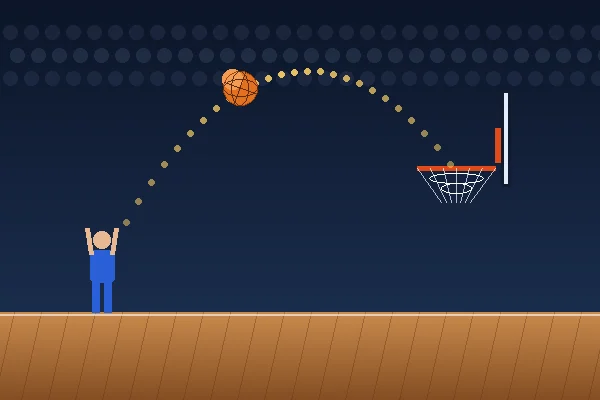
Basketball Precision Shot draws the entire flight path before you release. A simulation would never do this — it would destroy the uncertainty that makes a simulated shot dramatic. An arcade game does it because uncertainty about physics is not the interesting part; the moving hoop is.
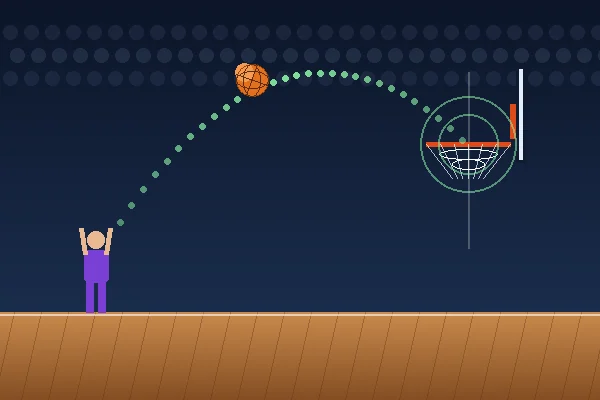
Basketball Time Attack draws the actual make window on the power bar. Again: the challenge is hitting the window, not discovering where it is.
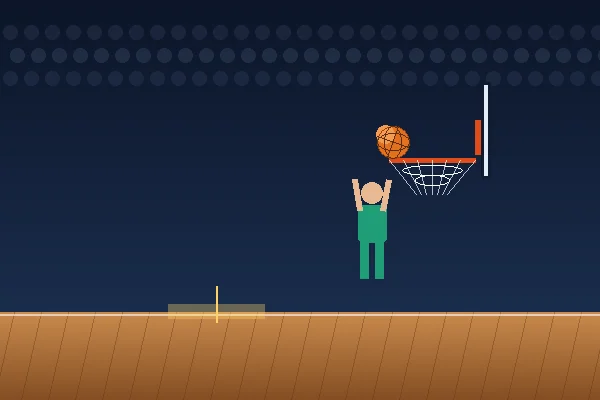
Dunk Challenge draws the take-off band on the floor, calculated from the jump maths. The game tells you exactly what correct looks like and then asks you to do it at speed.
This is a consistent philosophy: show the player the target, then make hitting it the game. A simulation would hide all three, and would be right to.
What arcade games are genuinely better at
- Teaching one mechanic fast. Twenty minutes gets you meaningfully better at a specific thing.
- Short sessions. Nothing is lost by stopping.
- Accessibility. One button, no vocabulary to learn, no reading required before playing.
- Legibility. Every failure is diagnosable, which is the foundation of improvement.
What simulations are genuinely better at
- Emergent situations. No arcade game produces a story.
- Long-term engagement. Seasons and progression sustain months.
- Modelling the real sport. If that is what you want, an arcade game is the wrong tool.
The same shot, in both genres
The clearest way to see the difference is to follow one shot through each.
In an arcade game. You choose an angle and a power. The game computes a trajectory from those two numbers plus gravity. The ball follows it exactly. If the trajectory passes through the rim, it goes in. If you repeat the same two numbers from the same position, you get the same result, every time, forever.
In a simulation. You choose a shot. The game considers the shooter's rating, their fatigue, the defender's position and contest level, the shot's difficulty from that spot, whether the shooter was moving, and often a timing input. Those combine into a probability. The game then rolls against it.
The second version is more accurate to real basketball, where identical-looking shots genuinely do go in sometimes and miss others. It is also, deliberately, less controllable.
Neither is a compromised version of the other. They are answers to different questions: "can you execute?" versus "did you make good decisions?".
Hybrids, and why they are hard
Some games try to sit in the middle — real physics for the ball, plus ratings and fatigue affecting the release. It sounds like the best of both and usually is not.
The problem is attribution. When you miss, was it your input or the simulation? If the player cannot tell, the feedback loop breaks in exactly the way arcade games avoid — and the emotional texture the simulation was after does not arrive either, because a missed input does not feel like a statistically unlucky shot.
The hybrids that work tend to separate the two cleanly: physics decides where the ball goes, and ratings decide what inputs are available rather than corrupting the ones you give. A lower-rated shooter gets a narrower timing window, not a randomised outcome. Same difficulty, intact feedback loop.
What each genre is for
Not a ranking — a matching exercise.
Choose arcade when you have under ten minutes, you want to improve at something measurable, you want to play without learning a vocabulary first, or you want to hand a device to someone else.
Choose simulation when you have an hour, you want narrative and stakes across a longer arc, you enjoy managing resources, or the appeal is the sport itself rather than a mechanic.
Choose arcade when you want to know exactly why you failed.
Choose simulation when you are happy for the answer to be "sometimes shots just miss".
A note on "realistic physics"
You will see the phrase on a lot of basketball games, and it usually means something narrow.
Almost every 2D basketball game uses real projectile motion — the parabola is genuine. Almost none models air resistance, spin, the Magnus effect, ball deformation or rim elasticity. So "realistic physics" typically means "gravity works", which is true and not very informative.
The games here use simplified projectile motion deliberately, and we say so. The simplifications are not limitations we regret; they are what makes the flight predictable enough to learn from. A game that modelled backspin accurately would be adding a variable you cannot see, and an invisible variable is indistinguishable from randomness.
That is the whole arcade philosophy in one sentence: remove what the player cannot observe.
Picking one
The honest question is not which genre is better but which one matches your next twenty minutes.
If you want to be immediately good at something small and see the number go up, that is arcade. If you want to inhabit a sport and make decisions that pay off slowly, that is simulation.
If you are in the first camp, the game directory is the place to start, and how basketball arcade games work explains the machinery.
Frequently asked questions
What is the difference between arcade and simulation basketball games?
An arcade game simplifies deliberately so the player can predict outcomes; a simulation preserves complexity so outcomes resemble real basketball. The dividing line is what each does with variables the player cannot directly see or control.
Are arcade basketball games less skilful?
No, they reward different skills. Arcade games test precision, timing and consistency in a narrow mechanic. Simulations test decision-making across a longer horizon. Both have high ceilings.
Which is better for a short break?
Arcade, clearly. A round lasts under two minutes, the rules are learnable in seconds and nothing is lost by stopping. A simulation expects a longer commitment.
Do arcade basketball games help you understand real basketball?
Only in the loosest sense — they reinforce that longer shots are worth more and that consistency matters. They are not a training tool and do not model real shooting technique.
References
External sources used in this article. Game mechanics described above come from the games’ own rules, which are documented on each game page.
- Projectile motion — HyperPhysics, Georgia State University — The physics arcade games simplify and simulations elaborate.