Basketball Arcade Guides
How Basketball Arcade Games Work: Physics, Scoring and Difficulty
The systems underneath every basketball arcade game — trajectory maths, rim collision, timing windows and difficulty curves — explained without the jargon.
A basketball arcade game looks simple and is, underneath, four systems working together: a physics model, a collision model, a scoring model and a difficulty model. Understanding them does not make you better at the games directly, but it does explain why the advice in our guides works.
1. The physics: projectile motion, minus the complications
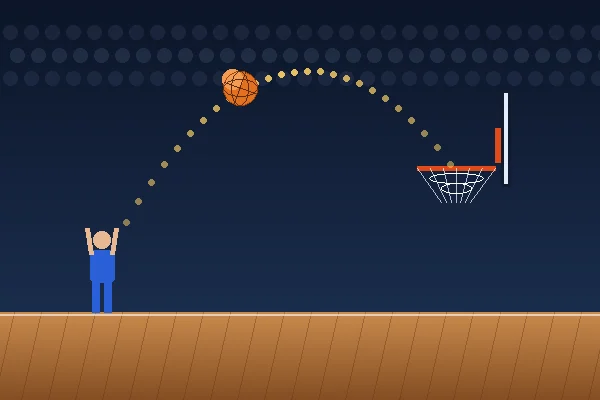
When you release a shot, the game gives the ball two numbers: a horizontal speed and a vertical speed, derived from the release angle and the power. From there it does the same thing every frame:
- Add gravity to the vertical speed.
- Move the ball by its speeds.
- Draw it.
That is genuinely all of it. It is the same projectile motion taught in introductory physics, and it produces the familiar parabola.
What these games leave out is as interesting as what they include:
Air resistance. Real basketballs are slowed by drag. At arcade scales the effect is small and it makes the trajectory harder to predict by eye, so it is almost always omitted.
Spin and the Magnus effect. Backspin genuinely affects a real shot. Modelling it adds a variable the player cannot see, which makes the game feel arbitrary. Left out.
Ball deformation. Real balls compress on impact. Games approximate the result with a bounce coefficient — the ball keeps some fraction of its speed after a collision — and leave the squashing to the animation.
The result is a model that behaves plausibly rather than accurately, which is the correct priority. A player needs to be able to predict the ball. For more on that distinction, see arcade versus simulation games.
The one equation worth knowing
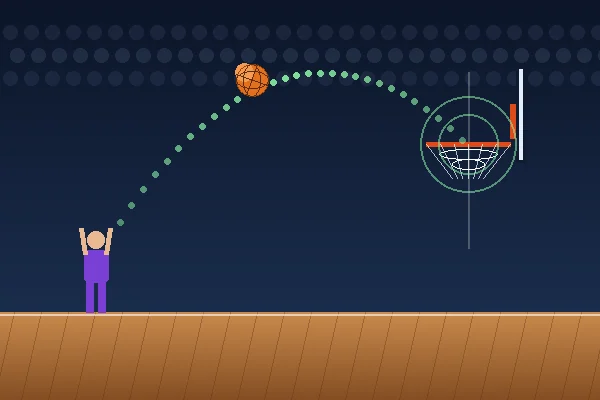
If you want to know why fixed-angle games feel the way they do, it comes down to this: for a given release angle, there is exactly one launch speed that puts the ball through the hoop from a given distance.
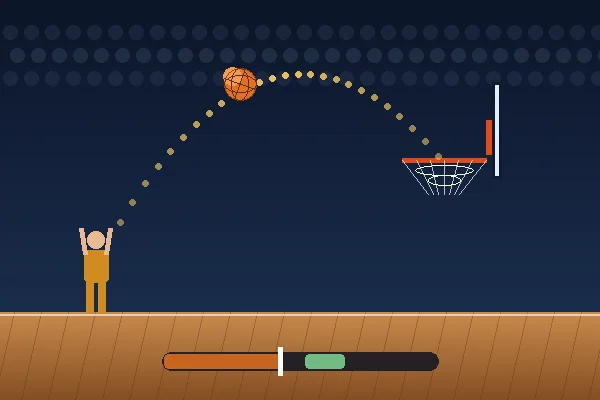
That is why the 3-Point Challenge can fix the angle at 56 degrees and still be a game — because every one of the five spots has a different distance, and therefore a different correct power. And it is why Basketball Time Attack can draw a green band on the power bar and promise that releasing inside it works: the band is that single correct speed, plus however much error the rim will tolerate.
2. Collision: why bank shots work
Detecting a made basket is easy. The game checks whether the ball crossed the horizontal line of the rim, going downwards, while positioned between the two rim tips. Downwards matters — otherwise a ball rising through the hoop from below would count.
Collision is more interesting. Most 2D basketball games model:
The rim as two small circles, one at each tip. When the ball overlaps one, the game reflects its velocity around the line connecting the two centres and scales it down. This is why rim bounces feel right, and why you occasionally get the lucky roll where a ball bounces off one tip, across, and in.
The backboard as a flat vertical surface. When the ball crosses it while at board height, the horizontal speed flips and shrinks.
That second one has a direct gameplay consequence: a slightly long shot can bank in. The board is a much larger target than the rim opening, so aiming deliberately at it is a legitimate way to widen your margin for error. That tip is in our shooting tips, and now you know why it works.
3. Scoring: why combos exist
A scoring system is a statement about what the designer wants you to do.
Flat scoring — every basket worth the same — produces one strategy: take as many shots as possible. Accuracy barely matters, because a miss costs only the time it took.
Distance scoring — more points from further out — introduces a real decision, and one with a clean break-even. A three-pointer is worth 1.5 times a two, so it is the better choice when your success rate from deep is more than about two thirds of your close-range rate.
Combo multipliers change everything. Because the multiplier applies to every subsequent score, a miss does not just fail to add points — it deletes the bonus on everything after it. That turns consistency from a nice-to-have into the dominant variable.
Accuracy grading goes further still. Basketball Precision Shot does not ask whether you made the shot but how centrally, paying fifteen, ten or six points accordingly. That rewards precision even on shots that would have counted anyway.
Decay is the sharpest tool of the set. Basketball Time Attack expires your combo 3.6 seconds after your last make, which converts hesitation from a neutral choice into a scored penalty.
4. Difficulty: the art of changing one thing
Difficulty in an arcade game is usually one of four levers:
Narrow the tolerance. Shrink the timing window or the rim. Most common, and the most likely to feel unfair if done invisibly.
Speed things up. More speed means less reaction time from the same tolerance.
Add movement. A static target becomes a moving one, converting a spatial problem into a temporal one.
Reduce the margin for error. Fewer lives, tighter clock, faster decay.
Good difficulty design shares one property: the player can see what changed. When the rim moves further away, you see it. When the meter speeds up, you see it. When the take-off band narrows, you see that too.
Difficulty that rises invisibly produces the same experience as a game that cheats, even when it is scrupulously fair. This is why every game on this site draws its windows on screen rather than hiding them — the band on the power bar in Time Attack and the band on the floor in Dunk Challenge are the actual tolerances, not illustrations of them.
5. The loop underneath
All of this runs inside a loop that the browser schedules roughly sixty times a second. Each pass: read input, advance the physics by the elapsed time, check collisions, update the score, draw.
Two details matter for players:
Delta time. Well-built games advance the simulation by actual elapsed time rather than a fixed amount per frame, so the game runs at the same speed on a 60Hz and a 144Hz display. Games that get this wrong run faster on better hardware.
Frame drops. When the browser cannot keep up, frames are skipped. Physics stays correct, but your timing degrades because you are seeing the meter less often. This is why battery saver mode and a dozen background tabs cost you accuracy — the cause is real, not imagined.
Why the simulation runs in small steps
A detail that matters more than it sounds like it should.
If a game moves the ball once per frame, a fast-moving ball can travel a long way between one frame and the next — far enough to pass completely through a thin rim without ever being at it on any frame the game checked. The shot goes through the hoop and nothing happens. This is called tunnelling, and it is the single most common physics bug in 2D sports games.
The fix is to advance the simulation in several smaller steps per frame and check for collisions after each one. The games here sub-step three times, which is enough at these speeds and cheap enough that it costs nothing measurable.
There is a second, related detail. A well-built game advances its physics by the actual elapsed time since the previous frame rather than by a fixed amount per frame. Without that, the game runs faster on a 144Hz display than on a 60Hz one — a real and surprisingly common bug that makes a high-refresh monitor a disadvantage.
Both of these are invisible when they work. They are only noticeable when they do not, which is why a game that "feels wrong" sometimes has nothing to do with its design.
The ball spins for a reason
The seams on the ball rotate as it flies. This changes nothing about where it lands — it is pure decoration — and it is one of the most valuable few lines of code in the game.
Rotation gives the eye something to track. A rotating ball reads as an object travelling through space; a static circle reads as a dot moving across a screen. The difference in how easy the flight is to follow is substantial, and it costs one multiplication per frame.
The same reasoning produces the other small touches: the net swaying after a make, the ball squashing slightly on a bounce, the score popup drifting upward and fading. None of it affects an outcome. All of it makes the outcome legible.
Designers call this layer juice, and the honest summary is that a game with good mechanics and no juice feels broken, while a game with weak mechanics and good juice feels fine for about ten minutes.
Sound as a second information channel
The games here generate their audio in code rather than loading files — a short oscillator tone shaped by an envelope, which is a handful of lines using the Web Audio API and weighs nothing.
What matters is that the sounds are distinct. A clean make, a rim contact and a miss produce different tones, which means you learn the result slightly before your eyes have finished processing it. In a game where your next input depends on the previous outcome, that head start is real.
This is also why sound is never the only signal for anything. Every event is visible as well as audible, because a game that requires audio excludes anyone playing silently — which, on a phone in public, is most people.
What actually makes an arcade game feel good
Pulling the threads together, five properties do most of the work:
Immediate response. The gap between input and visible reaction should be as close to zero as the platform allows. Anything that delays it — an animation that must finish, a confirmation step — breaks the loop.
Legible failure. You must be able to say in one sentence why you failed. This is the property that makes practice possible and the one most often missing.
Visible escalation. When the game gets harder, you should be able to see what changed.
A short restart loop. One press, no ceremony. In a genre where a round lasts a minute, three seconds of unskippable celebration is a tax on every attempt.
No hidden randomness. A correctly executed action must always succeed. Randomness in the situation is fine and often good — where the hoop appears, which spot comes next. Randomness in the resolution destroys the feedback loop.
Every one of those is a design choice rather than a technical constraint, which is why two games built on identical physics can feel completely different.
What this means for playing
Three practical consequences:
- Steeper arcs are more forgiving because a ball falling steeply passes through a wider
effective opening than one arriving flat. Physics, not preference.
- The backboard is a bigger target than the rim. Use it deliberately.
- Consistency beats volume in any game with a multiplier, and the gap is larger than it feels.
If you want those turned into practice, start with how to improve your arcade shooting accuracy.
Frequently asked questions
Do basketball arcade games use real physics?
They use real projectile motion — gravity, launch angle, launch speed — but simplified. Air resistance, spin and the Magnus effect are normally left out because they change the result very little at arcade scales and make the game harder to read.
Why does the ball bounce off the rim the way it does?
Most 2D games model the rim as two small circles, one at each tip, and reflect the ball off whichever it touches. It is a cheap approximation that produces convincing bounces, including the occasional lucky roll-in.
What is a timing window in game design terms?
A tolerance. The designer decides how wrong a player may be and still succeed, then expresses that as a span of time or distance. Narrowing it is the most common way to raise difficulty.
Why do arcade games use combo multipliers?
To make consistency worth more than volume. Without one, the optimal strategy in a timed game is to take as many attempts as possible; with one, it becomes a genuine trade-off between speed and accuracy.
References
External sources used in this article. Game mechanics described above come from the games’ own rules, which are documented on each game page.
- Projectile motion — HyperPhysics, Georgia State University — The trajectory equations arcade shooting games are built on.
- Canvas API — MDN Web Docs — How browser games draw each frame.
- requestAnimationFrame — MDN Web Docs — The timing mechanism behind smooth browser animation.