Basketball Shooting Games
How to Improve Your Basketball Arcade Shooting Accuracy
The four mistakes that cost most players their accuracy, and a 10-minute drill that tells you which one is yours.
Most advice about shooting in basketball games stops at "practise more". That is true and useless. Practice only helps when you can tell which thing you are getting wrong, and in an arcade shooting game there are only four things it can be. This guide is about telling them apart.
Everything below was tested against the games on this site, which is worth saying because specific numbers do not transfer between games. The reasoning does.
The four errors, and how each one looks
When a shot misses, watch where the ball goes rather than the score. Each error has a signature.
1. Too much power. The ball sails past the rim and hits the backboard high, or clears everything. On a fixed-angle game this is the most common miss by a wide margin, because the power meter is the only thing you control and overshooting feels like trying harder.
2. Too little power. The ball drops short and hits the front rim, or falls to the floor in front of the hoop. Beginners under-power far less often than they over-power, which is worth knowing: if you are missing in both directions, your problem is consistency, not calibration.
3. Wrong arc, right power. The ball arrives at the rim at the correct horizontal distance but travelling nearly sideways, so it hits the far rim and bounces out. This one is frustrating because the shot looks close. It is not close — a flat ball has almost no margin.
4. Right shot, wrong moment. The shot would have gone in if the hoop had stayed still. This only applies in games with a moving target, such as Basketball Precision Shot, and it is a timing problem rather than a shooting problem. The fix is in our timing guide, not this one.
Why arc matters more than power
Here is the part that changes how people play once it clicks.
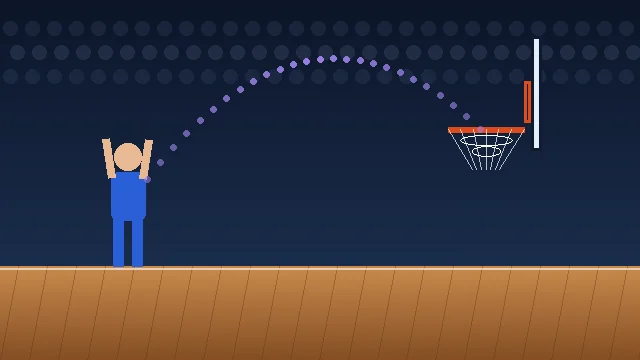
Imagine the rim as a target you have to drop a ball into. If the ball arrives travelling almost horizontally, the opening it has to pass through is effectively the thickness of the rim — a very small target. If it arrives falling steeply, the opening is the full diameter of the hoop.
That is why a steeper shot forgives errors that a flat shot punishes. The same power mistake that clangs off a flat shot will drop in on a steep one, because the ball is falling into the hoop rather than being thrown at it.
The practical consequence: when you have a choice of angle, choose a steeper one than feels natural. In Basketball Shooting Challenge, where you control both variables by dragging, most new players default to around 40 degrees because it looks like a direct route. Dragging higher — into the 50 to 60 range — and adding a little power makes the same shot noticeably more forgiving.
The trade-off is real and worth stating: steeper shots take longer to arrive and are more sensitive to power error in absolute terms. Past about 70 degrees you are throwing the ball nearly straight up and tiny power differences move the landing point a long way. The sweet spot is a band, not a point.
Learn against a preview first
The fastest way to build arc judgement is to use a game that shows you the answer.
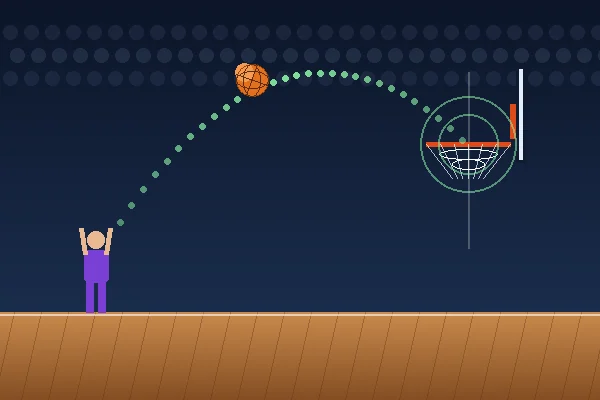
Basketball Precision Shot draws the complete flight path on screen before you release. That turns an invisible skill — "what does a good arc look like from here?" — into something you can simply read. Spend a few minutes watching where the dotted line falls at different angles and the shape starts to feel obvious.
Then move to a game that hides it. Basketball Shooting Challenge gives you the same preview while aiming, but the hoop relocates after every attempt so you cannot memorise a single setting. That is the intended progression: see it, then reproduce it.
The distance problem
Every shooting game is really a distance-estimation game wearing a costume.
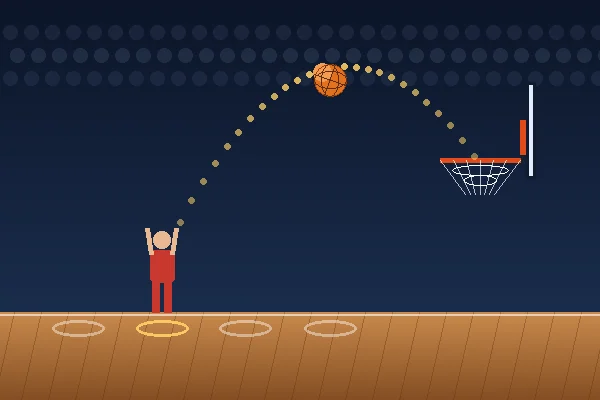
In the 3-Point Basketball Challenge the release angle is fixed at 56 degrees and the only variable is power. Because the five shooting spots sit at five different distances, the correct power changes every time you move — and nothing on screen tells you by how much.
This is where most players plateau. They learn the right power for one spot, shoot well there, and then miss everything from the next one because they carried the setting over.
Two habits fix it:
- Use the ghost marker. After each make, that game leaves a dashed line on the meter showing
where you released. When you move to a new spot, you are not guessing from nothing — you are adjusting from a known reference.
- Adjust in one direction at a time. If you missed long, move the release earlier and commit to
that. Alternating either side of the target on consecutive shots means you never find out which side you were on.
A drill that actually measures progress
Sessions feel good or bad for reasons that have nothing to do with skill. Use a number instead.
- Pick one game and stay on it. Switching mid-session makes the result meaningless.
- Play three full rounds. Do not restart a round because it started badly — bad rounds are data.
- Write down made shots and total attempts for each round. Both numbers appear on the game-over
screen in every game here.
- Calculate the percentage across all three rounds combined.
- Repeat tomorrow, same game, same three rounds.
Three rounds of the 3-Point Challenge is about three minutes of play and roughly forty attempts — enough that the number means something and short enough that you will actually do it again.
What to expect: a first session somewhere around 30 to 45 per cent is completely normal on a fixed-angle game. The jump from there to the mid-50s tends to come quickly once you stop over-powering. Past that, gains get slow and come from consistency rather than insight.
Five habits that separate steady shooters from streaky ones
Release on rhythm, not on certainty. Waiting for the meter to feel exactly right produces late releases. Pick the moment in advance and commit.
Reset after a miss, not after a make. Streaky players change something after every miss and nothing after a make. That is backwards — you learn more from a make you can repeat than from a miss you have already forgotten.
Watch one thing per session. Arc today, power tomorrow. Trying to fix everything at once produces the scattered pattern described above.
Do not chase the clock. In timed games, rushing costs more accuracy than it gains attempts. The maths is in our guide on getting higher scores — briefly, a combo multiplier makes a made shot worth several times a rushed one.
Stop while it is going well. Accuracy degrades with fatigue faster in timing games than almost any other genre. Twenty good minutes beats an hour of decline.
Where to practise each skill
| Skill you want to build | Best game for it | Why |
|---|---|---|
| Reading arc | Basketball Precision Shot | Draws the whole flight path before release |
| Controlling power | 3-Point Basketball Challenge | Fixed angle, so power is the only variable |
| Combining both | Basketball Shooting Challenge | Full control of angle and power, moving rim |
| Shooting under time pressure | Basketball Time Attack | 60 seconds and a combo that decays if you stall |
The variable nobody accounts for: rim height
Distance gets all the attention. Height quietly ruins more shots.
In several games here the rim does not sit at a fixed height — it relocates vertically as well as horizontally. Basketball Shooting Challenge moves it between roughly two thirds and half the height of the playfield, and the movement gets larger as your streak grows. Basketball Time Attack varies it on every single shot.
This matters because power and height interact in a way that is not intuitive. Raising the target by a small amount requires noticeably more power than moving it the same distance further away, because the ball has to fight gravity for longer on the way up and arrive with less forward speed remaining.
The practical version:
- A high, close rim needs more power than it looks like it needs. Most players under-power these
and hit the front rim.
- A low, distant rim needs less power than it looks like it needs. These produce the classic
sail-over-the-backboard miss.
- When both change at once, adjust for height first. It is the larger effect over the ranges
these games use.
If you take one habit from this section: before every shot, glance at where the rim sits vertically, not just how far away it is.
A four-week structure
Most people practise by playing. That works, slowly. This is faster, and each session is about fifteen minutes.
Week one — arc only. Basketball Precision Shot every session. Do not try to score well. Watch the previewed line at different release angles and build a mental picture of what a good shot looks like from a given distance. By the end of the week you should be able to predict where a shot lands before releasing.
Week two — power only. 3-Point Basketball Challenge. The angle is fixed, so every miss is a power error and therefore diagnosable. Use the ghost marker. Aim to be able to move between the five spots without a calibration miss each time.
Week three — both together. Basketball Shooting Challenge. Now the relocating rim tests the judgement you have built. Keep the angle fixed for the first two sessions, then start varying it.
Week four — under pressure. Basketball Time Attack. Everything from weeks one to three, plus a clock and a decaying combo. This is where you discover whether your accuracy survives being hurried, which is a separate skill from having it in the first place.
Track a three-round percentage at the end of each week, always on the same game. Week one's number is not comparable to week four's, so keep them as four separate lines rather than one.
Practising in five minutes
Not every session is fifteen minutes. If you have five:
Do one thing. Pick a single error — over-powering, flat arc, late release — and play one round watching only for that. One round with attention beats five without.
Or do a calibration lap. In the 3-Point Challenge, play one lap of five racks with the explicit goal of finding the correct power at each spot. Ignore the score entirely. You will end with a bad number and a better map.
Or play the turning-point drill. In Precision Shot, release only when the hoop is momentarily stationary at the top or bottom of its travel. Two minutes of this teaches patience more effectively than any amount of reading about it.
What not to do with five minutes: play your favourite game normally and hope. That is recreation, which is fine, but it is not practice and it will not move the number.
Three pieces of advice that sound right and are not
"Aim for the back of the rim." Borrowed from real basketball coaching, where it has a genuine basis in how a real ball behaves off a soft rim. In these games it just means aiming slightly long, and a long miss is the most common miss already.
"Shoot faster to get more attempts." In any game with a combo multiplier this is actively wrong — the multiplier loss from a broken streak outweighs the extra attempts. The arithmetic is in how to get higher scores.
"Find the perfect setting and repeat it." There is no single correct setting in any game here, because the rim moves. What you are building is a mapping from a situation to an input, not a single number to reproduce. People who look for one setting plateau early and stay there.
Measuring the thing you are actually trying to improve
Shooting percentage is the obvious number, and it is the wrong one to watch week to week, because it moves with which spots happened to come up.
Two better measures:
Miss direction spread. Over twenty attempts, note how many missed long versus short. A player who misses 15 long and 2 short has a calibration problem — one adjustment away from a big improvement. A player who misses 9 long and 8 short has a consistency problem, which is slower to fix and needs rhythm work rather than aim work.
First-shot-at-a-new-distance accuracy. This isolates judgement from memory. If you make most of your shots after the first one from a given position but miss the first, you are calibrating rather than reading — which is a specific, fixable gap.
A last word on plateaus
Most players hit a wall somewhere in the mid-50s on a fixed-angle game and conclude they have found their level. Usually what has happened is narrower: they have learned two of the five shooting spots well and are still guessing at the other three.
The test is simple. Next session, note your percentage per spot rather than overall. If one position is dragging everything down, that is not a plateau — that is a single unfinished piece of calibration, and it is the fastest point you have left.
Frequently asked questions
Why do I keep missing long in basketball arcade games?
Missing long almost always means too much power for the arc you are using, and it is the easiest error to fix because it is symmetrical: reduce power slightly, or raise the release angle and keep the power where it is. If your misses land beyond the backboard rather than on the back rim, the error is large — halve it rather than nudging it.
What is the best release angle in a basketball arcade game?
For a mid-range shot in most 2D arcade games, somewhere between 50 and 60 degrees gives the best balance of forgiveness and control. Below about 40 degrees the ball arrives too flat to drop through the rim; above about 70 it becomes very sensitive to small power errors. The games on this site that fix the angle use 56 and 58 degrees for exactly this reason.
How long does it take to get noticeably better?
Faster than most people expect, because arcade shooting is a small skill with immediate feedback. Twenty focused minutes spent on one game, using the drill in this guide, usually moves a shooting percentage more than several hours of unstructured play.
Does practising one game help in another?
Partly. Arc judgement transfers well between games that use similar physics. Specific power values do not transfer at all, because every game maps its meter to a different speed range.
References
External sources used in this article. Game mechanics described above come from the games’ own rules, which are documented on each game page.
- Projectile motion — HyperPhysics, Georgia State University — Background on the trajectory maths that arcade shooting games simplify.
- Canvas API — MDN Web Docs — Reference for how browser games draw and animate the court and ball.