Basketball Challenge Games
How to Get Higher Scores in Basketball Arcade Games
Making more shots is not the same as scoring more points. How multipliers and pacing really decide a high score.

There is a moment familiar to anyone who plays score-attack games: you have your best shooting round yet, and the final number is worse than a sloppier run from yesterday. Nothing has gone wrong. You have just discovered that accuracy and score are two different things.
This guide is about the gap between them.
The multiplier is usually the whole game
Start with the arithmetic, because it settles most arguments.
In Basketball Time Attack, a close-range basket is worth two points and the multiplier rises one step for every two consecutive makes, capping at x5. So:
- Two points made cold: 2 points
- The same shot on a x3 multiplier: 6 points
- The same shot on a x5 multiplier: 10 points
A player who makes eight shots in a row scores dramatically more than a player who makes twelve shots with misses scattered between them. Not slightly more — several times more.
This is the single most important fact about scoring in arcade games, and it flips the intuitive strategy. The instinct under a clock is take more shots. The maths says take shots you will make, because every miss does not merely fail to add points; it deletes the bonus on every point that follows.
Finding your actual optimal pace
Every timed game has a pace at which score is maximised, and it is not the fastest pace you can physically manage.
Here is how to find it in about six minutes.
- Play one round deliberately slowly — noticeably slower than feels right. Note the score.
- Play one round at your natural pace. Note the score.
- Play one round as fast as you can release. Note the score.
Nearly everyone finds the middle round wins, and a good number find the slow round beats the fast one. That result surprises people, and it is worth sitting with: the fast round usually has more attempts and fewer points.
Once you know which direction is better, nudge from there. The target is the fastest pace at which your accuracy has not started to drop — not the fastest pace at which you can still occasionally make one.
Shot selection: when distance is worth it
Games that pay more for distance create a genuine decision. On this site, both Basketball Time Attack and Basketball Shooting Challenge award three points from deep instead of two.
The break-even is straightforward. A three is worth 1.5× a two, so the deep shot is worth taking when your success rate from distance is more than 1 / 1.5 = about 67 per cent of your close-range rate.
In practice:
- Make 60 per cent close and 45 per cent deep? Take the deep shot. (45 ÷ 60 = 75 per cent.)
- Make 60 per cent close and 30 per cent deep? Do not. (30 ÷ 60 = 50 per cent.)
And there is a second cost the arithmetic above ignores: a missed deep shot also breaks your multiplier. That pushes the real break-even slightly higher than 67 per cent. If you are close to the line, take the safer shot.
The exception is the end of a round. With five seconds left and no time for a combo to matter, take the highest-value shot available — there is nothing left to protect.
Scoring tables, game by game
The reason generic advice fails is that these systems genuinely differ. Here is what each game on the site actually rewards.
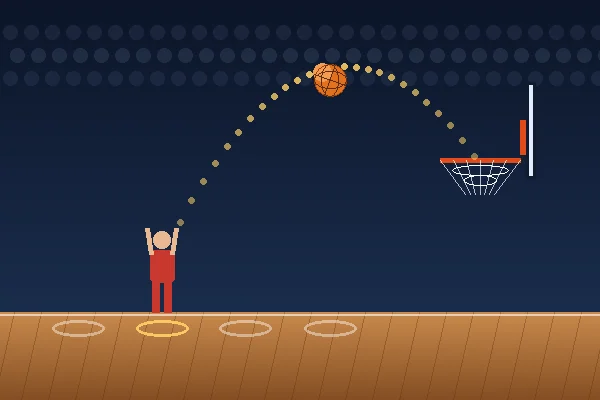
Basketball Shooting Challenge — two points close, three from deep, multiplied by a streak bonus that rises every three consecutive makes to a cap of x4. A shot that goes through without touching the rim adds one extra point. Implication: clean shooting is worth chasing here specifically, because the swish bonus is additive on top of the multiplier.
3-Point Basketball Challenge — two points per make, three for the final ball of each five-ball rack, plus one extra point per make once you are three makes into a streak. Implication: the money ball is worth prioritising, and a streak carried into a rack is worth more than a streak started inside one.
Dunk Challenge — ten points for a dunk, four for a layup, times a multiplier that rises every three consecutive finishes to a cap of x4. Implication: a layup is worth taking when you are not confident, because it keeps the combo alive at 40 per cent of the value rather than resetting it to zero.
Basketball Hoop Rush — one point per hoop, three for a centred pass, plus one more once you are five hoops into a streak. Implication: aiming for the centre line is worth up to four times as much as scraping through, and costs nothing.
Basketball Precision Shot — fifteen, ten or six points graded on how centrally the ball passes through, times a multiplier rising every two makes to x5. Implication: this is the most multiplier-dominated game on the site. Protect the streak above all.
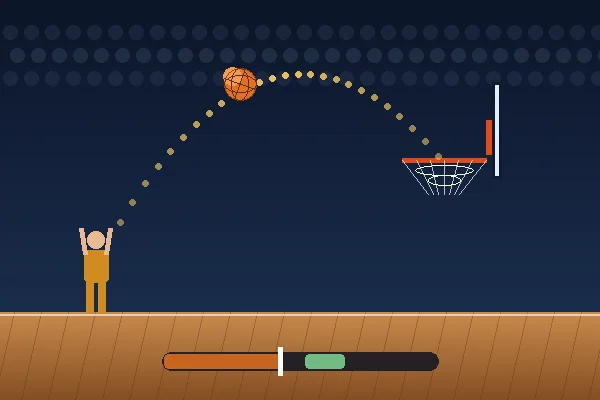
Basketball Time Attack — two or three points by distance, times a multiplier rising every two makes to x5, with the combo expiring after 3.6 seconds without a make. Implication: this is the one game where hesitating actively costs you, because the combo decays on a timer rather than only on a miss.
Endless games are a different problem
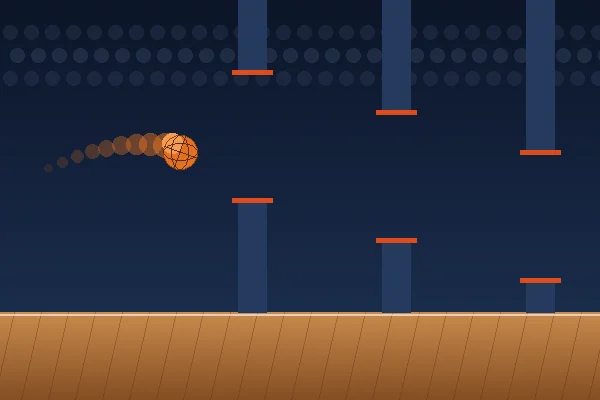
Basketball Hoop Rush has no clock and no win condition. It just accelerates until you fail. That changes the objective completely: you are not maximising points per second, you are maximising seconds.
The correct strategy in a survival game is almost always the boring one.
- Stay near the middle of the screen vertically. It gives you room to correct in either
direction when a hoop arrives high or low.
- Tap smaller and more often. Large corrections overshoot; small ones are recoverable.
- Do not chase the centre bonus once the speed is high. Three points is not worth a run.
- Expect the difficulty step at twenty hoops. That is when some hoops start drifting vertically.
Knowing it is coming is most of the battle.
Things that feel productive but are not
Restarting after a bad opening. A run that starts badly still teaches you the pattern, and restart-spamming trains nothing but the first ten seconds.
Playing five games in a session. Score improvement is game-specific. Thirty minutes on one game beats thirty minutes spread across six.
Chasing a score you saw once. Best scores are partly variance. A number you hit once is not your level; the number you can hit most sessions is.
Turning the sound off to "focus". Several games here use audio as scoring feedback — the cue that tells you a shot went clean rather than off the rim. Keeping it on gives you information a fraction of a second earlier.
A worked example: two players, identical accuracy
This is the clearest demonstration of why the multiplier dominates.
Two players each take twelve shots in Basketball Time Attack and each makes eight. Identical accuracy — 67 per cent. Assume every basket is a close-range two-pointer, and that the multiplier rises one step every two consecutive makes to a cap of x5.
Player A makes eight in a row, then misses four:
| Shot | Result | Multiplier | Points |
|---|---|---|---|
| 1 | Make | x1 | 2 |
| 2 | Make | x1 | 2 |
| 3 | Make | x2 | 4 |
| 4 | Make | x2 | 4 |
| 5 | Make | x3 | 6 |
| 6 | Make | x3 | 6 |
| 7 | Make | x4 | 8 |
| 8 | Make | x4 | 8 |
| 9–12 | Miss | — | 0 |
Total: 40 points.
Player B alternates make, miss, make, miss for all twelve:
Every make happens at x1, because the multiplier never survives to the next shot.
Total: 16 points.
Same shooting percentage. Two and a half times the score. Nothing about Player A's shooting was better — only the order of their results differed, and order is the thing you can influence by choosing which shots to take.
This is why "take shots you will make" beats "take more shots" in almost every situation, and why the biggest single improvement available to most players is not accuracy at all.
When to break your own rule
Combo protection is the default, not a law. Four situations where the opposite is correct:
The last few seconds of a timed round. With no time left for a multiplier to compound, the expected value of a risky high-value shot is simply its value. Take the deep shot.
When the combo has already expired. In Time Attack the combo dies 3.6 seconds after your last make. If it has gone, you have nothing to protect and the calculus resets to pure expected value.
When you are one point from a personal best. Scores are not linear in satisfaction. If a risky shot is the only route to beating your record and a safe one is not, take the risk — you are optimising for the record, not for the expected score.
In a survival game near the end of a run. This one is counter-intuitive but follows from the same logic in reverse: in Basketball Hoop Rush, late in a run at high speed, the centring bonus is not worth the risk. The "risk" and "safe" labels swap depending on what the score is actually measuring.
The tilt spiral, and how to stop it
Almost every bad round follows the same shape. A miss. Frustration. A rushed release. A second miss. More frustration. By twenty seconds after the first mistake, the round is unrecoverable — not because of the first miss, but because of everything that followed it.
Three things that interrupt it, in order of effectiveness:
Take one deliberately slow shot. Costs about a second. Resets the rhythm that was making you accurate, and rhythm is the thing that actually broke.
Say what went wrong. Silently naming it — "that was long", "I released early" — converts an emotional response into a diagnostic one. It sounds trivial and it measurably helps, because you cannot ruminate and diagnose at the same time.
Accept the round. Sixty seconds is short. A round that has gone badly is worth finishing for the information rather than restarting for the fresh start, and restart-spamming trains only the opening ten seconds.
Tracking progress in a way that is not misleading
Best scores are a bad measure of skill. They are the right tail of a distribution, which means they move mostly with variance and with how many attempts you have made.
Better, in order of usefulness:
Three-round average. Play three rounds, average them, record one number. It moves when you improve and stays put when you get lucky.
Personal-best frequency. How often you come within, say, 10 per cent of your best. A player who touches their best score one round in three is genuinely better than one who hit it once a month ago, even if the peak number is the same.
Longest combo. In multiplier-driven games this is the most direct measure of the thing that actually produces points, and it is far less noisy than the final score.
Write them down. Three lines in a note is enough, and the reason to do it is that memory of a gaming session is almost entirely shaped by how it ended.
A practical ten-minute routine
If you want a structure rather than a list:
- Minutes 0–2. One round at deliberate pace. Ignore the score entirely; watch where misses go.
- Minutes 2–6. Three rounds at your natural pace, writing down each score.
- Minutes 6–8. One round where the only goal is to protect a single long combo, even if you take
half as many shots.
- Minutes 8–10. One round at full speed, to see what accuracy costs you.
That last round is the one that teaches most players the lesson this guide is built around.
Frequently asked questions
Is it better to shoot quickly or accurately?
Accurately, in almost every case, because combo multipliers compound. In Basketball Time Attack a shot made at a x4 multiplier is worth eight points where the same shot at x1 is worth two — so one made shot inside a live combo beats four rushed attempts that break it.
What is a combo multiplier?
A running bonus applied to the base value of each score, raised by consecutive successes and reset by a failure. On this site the multiplier caps at x4 or x5 depending on the game, and each game page states its own formula.
Should I always take the three-point shot?
Only if you make it reliably. A three is worth 50 per cent more than a two, so it pays off when your success rate from deep is more than about two thirds of your close-range rate. Below that, taking it lowers your expected score and risks your multiplier.
Why does my score drop when I try harder?
Because "trying harder" in a timing game usually means releasing earlier, which lowers accuracy, which breaks combos. The multiplier loss outweighs the extra attempts.
References
External sources used in this article. Game mechanics described above come from the games’ own rules, which are documented on each game page.
- Web Storage API — MDN Web Docs — How browser games store high scores locally without an account.