Basketball Challenge Games
Basketball High Score Strategies for Every Game Type
Timed, endless and life-limited games reward opposite behaviour. A strategy for each, with the reasoning.
The most common high-score mistake is not poor execution. It is applying a strategy that belongs to a different kind of game.
Arcade basketball games come in three shapes, and each one rewards behaviour the others punish.
Shape one: the timed round
Example: Basketball Time Attack, the 3-Point Challenge, Basketball Shooting Challenge.
A fixed window — sixty seconds — and a score that only counts what happened inside it.
What this rewards: pace. Not maximum speed, but a sustainable rhythm. The whole game is a trade-off between attempts and accuracy, and the score is maximised somewhere in the middle.
The specific trap: rushing after a miss. The multiplier reset stings, the instinct is to make it back quickly, and the rushed shots that follow break the rhythm that was working.
What to do instead:
- Establish a pace in the first ten seconds and hold it.
- After any miss, deliberately slow one shot down before resuming.
- In the final five seconds, abandon combo protection and take the highest-value shot available —
there is no time left for a multiplier to compound.
Time Attack adds one twist: the combo expires after 3.6 seconds without a make. In that game, hesitation is not merely neutral, it is actively scored against you. Keep moving.
Shape two: the endless run
Example: Basketball Hoop Rush.
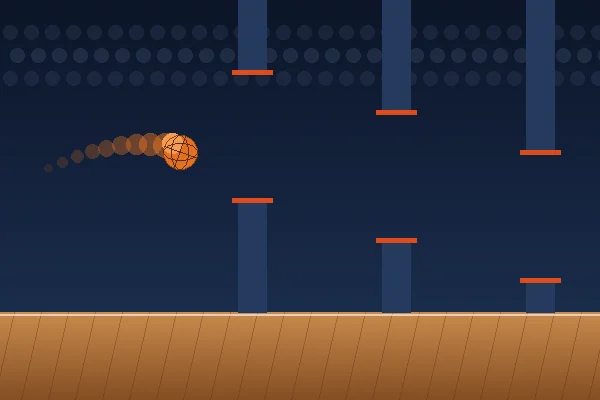
No clock, no finish line. It accelerates until you fail.
What this rewards: survival. The score is a proxy for duration, which means the safe route is also the high-scoring route. This is the shape where "playing well" and "playing carefully" are the same thing.
The specific trap: chasing bonuses. Hoop Rush pays three points for a centred pass instead of one. At low speed, going for the centre is free. At high speed, a centring correction is a risk — and a run that ends at hoop forty scores less than a cautious run that reaches hoop sixty.
What to do instead:
- Stay near the vertical middle when you have the choice. It preserves room to correct either way.
- Make small, frequent inputs rather than large corrections.
- Go for the centre bonus early, ignore it late.
- Know that the difficulty steps at twenty hoops, when some start drifting vertically. Expect it
rather than being surprised by it.
Shape three: the life-limited run
Example: Basketball Precision Shot, Dunk Challenge.
No clock at all. A fixed number of failures ends it.
What this rewards: patience — and this is the shape most players play worst, because they carry timed-game instincts into it.
Here is the key insight: if there is no clock, waiting costs nothing. In Precision Shot the hoop drifts up and down on a sine path, which means it is briefly almost stationary at the top and bottom of its travel. Those two moments are dramatically easier than any other. Waiting for them is free.
Most players never do. They shoot on a rhythm inherited from timed games and spend their five lives on shots they did not need to take.
What to do instead:
- Identify what the easy moment looks like, and only shoot then.
- In Dunk Challenge, take the layup when unsure — it keeps the combo and costs no life.
- After losing a second life, become conservative. Everything you score afterwards is multiplied by
a combo you only have because you survived.
Comparing the three
| Timed | Endless | Life-limited | |
|---|---|---|---|
| Main resource | Seconds | Nothing (speed rises) | Lives |
| Rewards | Pace | Survival | Patience |
| Cost of waiting | High | None | None |
| Cost of a mistake | Multiplier reset | Run over | One life + multiplier |
| Late-run adjustment | Take value shots | Get safer | Get much safer |
The row that matters most is cost of waiting. It is the single variable that determines whether aggression is correct.
Habits that work everywhere
Learn the scoring table first. Every game page here lists exactly what each action is worth. Five minutes reading it is worth more than an hour of trial and error.
Play one game per session. High scores are game-specific, and the calibration you build in one does not transfer to another.
Track three-round averages, not best scores. Your best is partly luck. Your average is your level, and it is the number that moves when you actually improve.
Stop when timing degrades. In every shape, the first sign of fatigue is releasing late. It is not something to push through.
A worked plan for each format
Abstract strategy is easy to agree with and hard to use. These are concrete.
Timed round — Basketball Time Attack
Seconds 0–10. Establish pace. Take four or five shots at a rhythm you can hold. Do not chase deep shots yet; you want a combo running.
Seconds 10–45. Hold the rhythm. Take the deep shot only when it is close enough that your confidence is genuinely high. Watch the combo timer more than the clock — it is the thing that will cost you.
Seconds 45–55. If your multiplier is at or near the cap, keep protecting it. If it has broken recently, stop rebuilding and start taking value shots.
Seconds 55–60. Take the highest-value shot available regardless of confidence. There is nothing left to protect.
Endless run — Basketball Hoop Rush
Hoops 1–10. Go for the centre bonus on everything. It is nearly free at this speed and it builds the streak bonus that kicks in at five.
Hoops 10–20. Keep centring where the approach is comfortable, take the safe line where it is not.
Hoop 20. Expect drifting hoops. Stop chasing the bonus.
Hoops 20+. Survival only. Small, frequent taps. Stay near the vertical middle whenever the next opening allows it.
Life-limited run — Basketball Precision Shot
Lives 5 and 4. Shoot at turning points only. There is no clock; patience costs nothing and the combo is worth more than the tempo.
Lives 3 and 2. Same, but stop taking anything that requires leading a fast-moving hoop. A x5 multiplier is worth several careful shots.
Life 1. Turning points exclusively, even if that means waiting several seconds between shots.
A session designed to beat a personal best
Best scores are set under specific conditions, and you can create those conditions deliberately.
Warm up on the wrong game. Two minutes on something with a different rhythm, so you arrive at the target game fresh rather than stale.
Play three rounds without trying. Low stakes, no expectations. This is calibration.
Then attempt the record on round four or five. This is when most personal bests land — warmed up but not yet tired.
Stop after two failed attempts. Timing degrades quickly, and chasing a record while degraded trains the degraded version.
Do not chase it across sessions. If the record does not fall today, come back. Best scores fall to fresh attempts far more often than to persistent ones.
Why your best score is a bad measure of your skill
Worth internalising, because it changes how a session feels.
A best score is the maximum of a distribution. Maxima move with the number of attempts, not just with skill — play twice as many rounds and your best will rise even if you have not improved at all.
Two players with the same true ability can have best scores 30 per cent apart purely because one has played more rounds.
What actually tracks skill: your median round, and how often you come close to your best. If one round in three is within ten per cent of your record, that record is your level. If you hit it once and never again, it was a good night.
What a realistic improvement curve looks like
Progress in these games is not linear, and knowing the shape stops people giving up in the flat part.
- First few runs: rapid improvement as you learn the rules and the controls.
- Next several: a plateau, often a frustrating one, while calibration catches up.
- Then a jump: usually when one specific insight lands — the turning-point trick in Precision
Shot, the layup decision in Dunk Challenge, the pacing trade-off in a timed game.
- After that: slow, steady gains from consistency alone.
The plateau is the normal part. It is also where most people quit, one insight short.
Frequently asked questions
What is the difference between a timed game and an endless game?
A timed game gives you a fixed window and asks how much you can score inside it, so pace matters. An endless game has no end state except failure, so the score is really a measure of how long you survived — and the safest play is usually the highest-scoring one.
Why is patience a strategy in some games and not others?
Because waiting only costs something when there is a clock. In a life-limited game with no timer, such as Basketball Precision Shot, waiting for a favourable moment is free — so taking a difficult shot when an easy one is coming is a straightforward mistake.
Do high scores sync between devices?
No. Scores are stored locally in your browser on each device, with no account and nothing uploaded. A phone score and a laptop score are separate records.