 Challenge
Basketball Hoop Rush
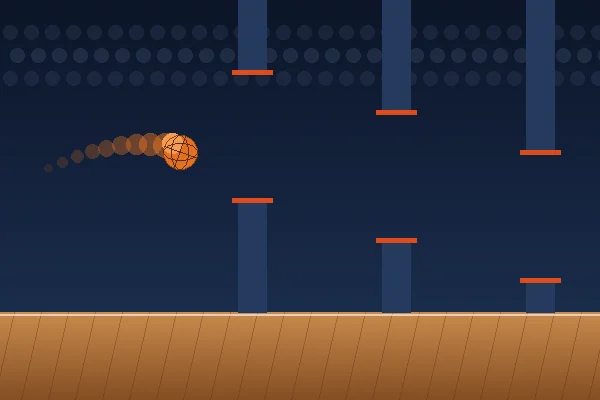
Tap to keep the ball airborne and thread it through hoop after hoop as the court accelerates beneath you.
One button
Dunk · Timing and run control
Finish as many dunks as possible before three misses end the run. Every cleared round runs faster and narrows the take-off window.
Dunk Challenge is a timing game with one extra layer. Your player runs at the rim automatically, the jump is a fixed arc, and the only decision is when it starts — but you can brake or sprint during the run-up, which changes where the take-off window sits and how wide it is.
The band drawn on the floor is not decoration. It is calculated from the jump's flight maths: take off inside it and the top of your jump arrives exactly at the rim. Watch the band rather than the hoop, because the correct take-off point moves with your speed and the game changes your speed every round.
Miss and the game tells you which way you were wrong. "Too early" means you peaked before reaching the rim; "too late" means you were still rising when you got there. Most players get one of these far more often than the other, which turns a vague skill problem into a single directional correction.
Three misses ends the run. Each cleared round raises the speed and narrows the tolerance.
right speeds you to about a third faster. Both move the band and change its width.
earlier. "No jump" means you ran past the rim.
alive.
Every game on this site is also fully playable with the keyboard alone — the on-screen buttons are reachable with Tab and work with Enter or Space. The full reference is in the controls guide.
| Event | Points |
|---|---|
| Dunk (tight window) | 10 × multiplier |
| Layup (wider window) | 4 × multiplier |
| Combo multiplier | x1, rising one step every 3 consecutive finishes, capped at x4 |
| Miss | Combo resets, one life lost |
Difficulty per round: run speed starts at 300 units per second and rises by 22 each round to a cap of 620. The dunk tolerance starts at 26 units and tightens by 1.7 each round to a floor of 9. The layup window is always about 2.4 times the dunk window.
Watch the floor, not the rim. The single largest difference between players who clear five rounds and players who clear fifteen.
Sprint when your misses are one-sided, brake when they are scattered. Sprinting widens the band in distance but leaves less time to react; braking narrows it but slows everything down. Which one helps depends on whether you need a bigger target or more time.
Take the layup when unsure. A layup at x3 is twelve points and keeps the chain. A missed dunk is zero, resets the multiplier and costs a life.
Recalibrate on the first attempt of each round. Both the speed and the tolerance change together; carrying the previous round's rhythm across usually costs a life immediately.
After the second miss, brake and play safe. Surviving into a high-multiplier round is worth more than any single dunk.
The full technique guide is basketball dunk game tips.
Press when your player reaches the middle of the highlighted band on the floor. The band is calculated from the jump maths — take off inside it and the top of your jump lands at the rim.
They change your run speed, which moves the take-off band and changes its width. Sprinting makes the band wider in distance but gives you less time to react; braking does the opposite.
The dunk needs the tighter window and pays ten points; the layup has a window about 2.4 times wider and pays four. Both keep your combo alive, which is why the layup is often the better choice.
Three. Running past the rim without jumping counts as one.
Yes, every round. The run speed rises and the timing tolerance tightens, which is why the first attempt of a new round should be treated as recalibration.
Games that use the same skills, or make a good next step.
Challenge
Tap to keep the ball airborne and thread it through hoop after hoop as the court accelerates beneath you.
 Featured
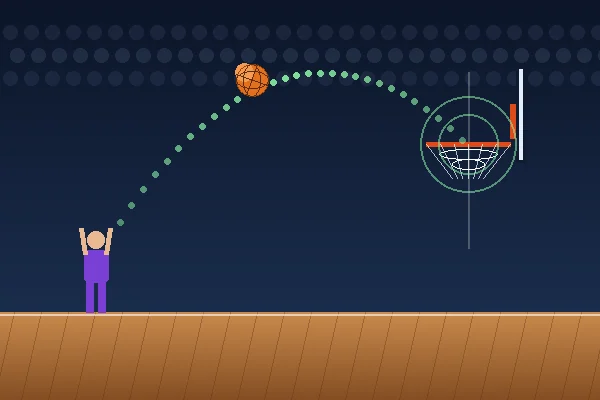
The flight path is drawn for you before every shot. The hoop is what makes it hard — it drifts, then it drifts faster.
 Featured
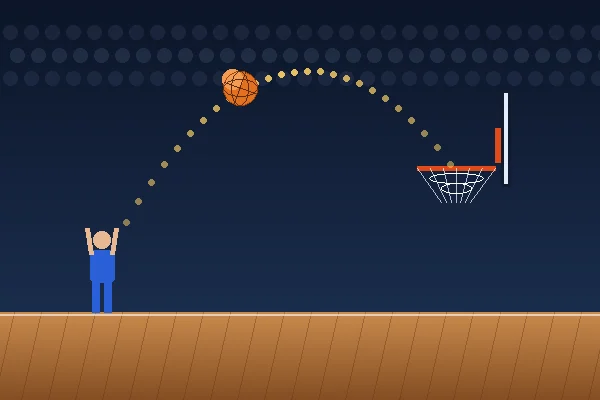
Set your own angle and power, then shoot against a 60-second clock as the rim moves further away with every make.