Basketball Dunk Games
Dunk Games: What Makes a Good One, and How to Play Them
What separates a satisfying dunk game from a frustrating one — and the one habit that doubles most players’ scores.

Dunk games are the most immediately satisfying corner of the genre and the easiest to get wrong. The finishing animation does a lot of emotional work, which tempts designers into building a game where the animation is the reward and the input barely matters.
The good ones do the opposite.
What a good dunk game does
It shows you the window. The take-off point is the whole game. A dunk game that does not draw it is asking you to discover an invisible tolerance by trial and error — which is not difficulty, it is obscurity.
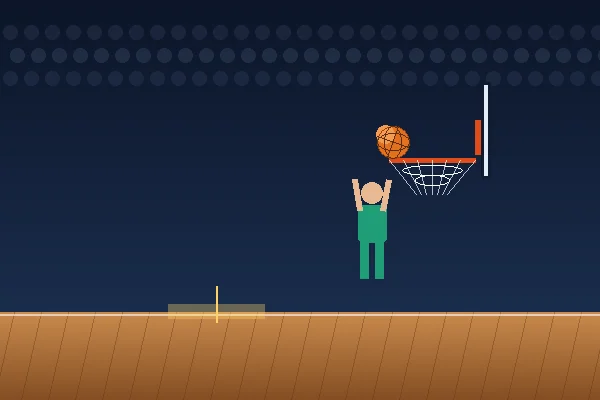
Dunk Challenge draws a band on the floor that is calculated from the jump's flight maths. Take off inside it and the top of your jump lands at the rim. That is not an illustration of the window; it is the window.
It tells you which way you were wrong. "Too early" and "too late" are opposite problems with opposite fixes. A game that says only "miss" leaves you guessing, and most players guess wrong because everyone's internal estimate is biased late.
It gives you something to do while running. A pure "press at the right moment" game is thin. The run-speed control in Dunk Challenge — braking to about two thirds speed, sprinting to about a third faster — turns the approach into a decision rather than a wait.
The trade-off is genuine: sprinting widens the take-off band in distance but leaves less time to react to it; braking does the reverse. Neither is correct in general, which is what makes it a choice.
It has a middle outcome. A dunk game where every attempt is either a slam or a miss is brutal. Having a layup — a wider window, lower reward, combo preserved — gives you something to aim at when you are unsure, and that turns a coin flip into a judgement.
What a bad one does
Hides the timing. Covered above. The single most common failing.
Adds invisible randomness. If the same take-off sometimes works and sometimes does not, the feedback loop is broken and the game cannot be learned.
Pads the loop. Long celebration animations after every dunk. In a game whose core loop is three seconds, anything unskippable is a tax.
Punishes without explaining. Difficulty that rises invisibly reads as the game cheating even when it is perfectly fair.
The one habit that doubles most scores
Take the layup.
The arithmetic: a dunk pays ten points, a layup pays four. Both keep your combo alive, and the combo multiplier rises every three consecutive finishes to a cap of x4.
So a layup at x3 is worth twelve points and keeps the chain going. A missed dunk is worth zero, resets the multiplier to x1, and costs one of your three lives.
The layup window is roughly two and a half times as wide as the dunk window. That is a very large amount of forgiveness in exchange for a 60 per cent pay cut on a single attempt — and the cut is much smaller than it looks once you account for what a reset multiplier costs on the next several attempts.
Most players know this in the abstract and still go for the dunk every time. Changing that one habit is usually worth more than any amount of timing practice.
Watch the floor, not the rim
The instinct is to watch the hoop and jump when it looks close. That fails for a specific reason: the correct take-off point moves depending on how fast you are running, and the game changes your speed every round.
The band on the floor already accounts for this. Watch it instead.
This sounds trivial and is the largest single difference between players who clear five rounds and players who clear fifteen.
Reading the failure messages
| Message | What happened | Fix |
|---|---|---|
| Too early | Jumped before the band; peaked short of the rim | Take off later |
| Too late | Jumped after the band; still rising on arrival | Take off earlier |
| Short | Landed before reaching the rim | Jump much later, or sprint |
| No jump | Ran past the rim | Press sooner |
Note which one dominates a round. Most players get one far more often than the others, which makes the correction a single directional adjustment rather than general practice.
After the second miss, get conservative
Three misses ends the run. That means your second miss should change how you play.
Brake. Score more slowly. The objective has shifted from maximising points per round to surviving into rounds where your multiplier is already high — and everything you score there is worth several times what you gave up by being careful.
The physics of a fixed jump
Understanding this makes the genre click.
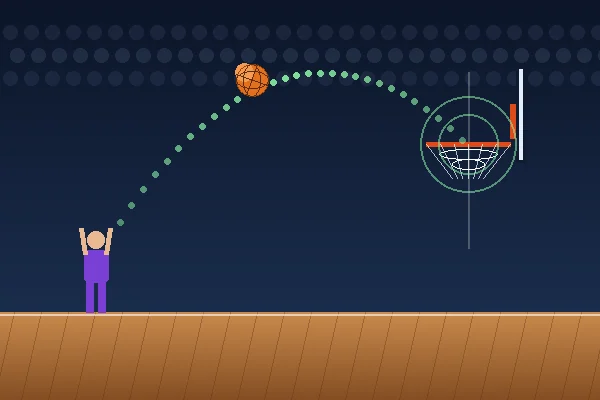
A jump in a dunk game is a projectile, exactly like a shot. It has a fixed upward impulse and gravity brings it back down, which produces a parabola with a fixed height and a fixed duration in the air.
Two consequences follow, and they explain almost everything about how these games play:
The peak is always at the same moment. Halfway through the airtime, every time. You cannot jump higher by pressing harder, and you cannot stay up longer.
Where the peak happens in space depends on your speed. Running faster means covering more ground during the same airtime, so the peak lands further forward. This is why the correct take-off point moves when your speed changes, and why the band in Dunk Challenge slides as you brake or sprint.
Once you see the jump as "a fixed arc that I get to position", the game stops being about reflexes and starts being about placement.
Why the animation matters more than it should
A dunk game has a structural problem: the finish is the most satisfying part and the least interactive. Everything that decides the outcome happened at take-off; the dunk itself is a result being displayed.
That tempts designers into making the animation the reward — long, elaborate, unskippable. It works for about ten attempts and then becomes a tax, because in a genre where the loop is three seconds, two seconds of celebration doubles the cost of every attempt.
The better answer is to make the animation informative. A dunk that visibly differs from a layup tells you which outcome you got before the score updates. A clean finish that looks different from a scraped one gives you a sense of margin. That is feedback rather than ceremony, and it costs no extra time.
Progression expectations
Knowing the shape of the curve stops the middle feeling like failure.
Rounds 1–3. You are learning where the band is. Most misses are "too late", because almost everyone's internal estimate is biased late.
Rounds 4–7. The window tightens noticeably and the speed rises. This is where most players lose their first run, usually to an overcorrection after a single miss.
Rounds 8–12. The layup decision starts to matter. Players who go for the dunk every time plateau here; players who take the safe finish when unsure keep going.
Rounds 13+. Near the speed cap and the tolerance floor. Every attempt is a real commitment, and brake-and-survive becomes a legitimate strategy after the second miss.
If you are stuck around round six, the fix is almost always directional — read which failure message dominates and correct only that. If you are stuck around round eleven, the fix is almost always strategic, and it is the layup.
Dunk timing versus shooting timing
They feel similar and train different things, which is worth knowing if you are choosing what to practise.
Shooting timing is about a value: how much power, what angle. The input has a magnitude, and being slightly wrong produces a slightly wrong result.
Dunk timing is about a moment: when. The input has no magnitude, and being slightly wrong produces a completely different outcome — dunk, layup or miss, with sharp boundaries between them.
That sharpness is why dunk games feel harsher even when their windows are objectively generous, and it is why the middle outcome matters so much. Without a layup, every attempt would be pass-or-fail on a knife edge.
If you want the same instinct on a gentler curve, Basketball Hoop Rush uses continuous small corrections instead of single committed inputs — the same rhythm sense, much less punishment for being slightly off.
Related games worth your time
Dunk timing is a rhythm skill, and it transfers to other rhythm games more than to shooting games.
Basketball Hoop Rush uses the same instinct on a much shorter loop — continuous small corrections rather than one big committed input.
Basketball Precision Shot is the shooting-side equivalent: a single timed release against a moving target, where waiting for the right moment is free.
For the detailed technique, basketball dunk game tips covers brake-versus-sprint and the calibration routine in full.
Frequently asked questions
What makes a dunk game good?
A visible take-off window and a legible failure state. If you can see where you were supposed to jump and the game tells you which way you were wrong, the game is teachable. If neither is true, it will feel random however fair it actually is.
How do I get a higher score in a dunk game?
Take the layup when you are not confident. It scores less but keeps the combo multiplier alive, and the multiplier is worth more than the difference between a dunk and a layup.
Why do dunk games get harder?
They narrow the timing tolerance and raise the speed. In Dunk Challenge both happen every round, which is why the first attempt of a new round should be treated as recalibration.
Are dunk games good on mobile?
Very. They are one-button games with short rounds. Dunk Challenge needs the on-screen bar for brake and sprint, which appears automatically on touch devices.