 Featured
Basketball Shooting Challenge
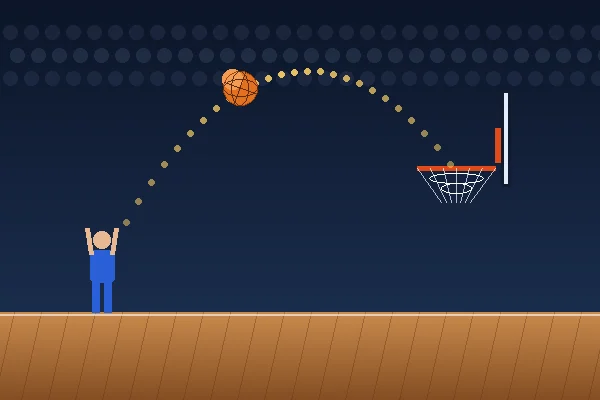
Set your own angle and power, then shoot against a 60-second clock as the rim moves further away with every make.
Drag to aim
Shooting · Rack shooting contest
Work through five shooting spots at increasing distance, five balls at each, before the 60-second clock runs out. The last ball in every rack is worth an extra point.
The 3-Point Basketball Challenge is a rack-shooting contest against a sixty-second clock, and it is the hardest game on the site.
The release angle is fixed at 56 degrees. The only thing you control is power, chosen by stopping a meter that sweeps back and forth. That sounds simple until you realise the five shooting positions sit at five different distances — so the correct release point changes every time you move, and nothing tells you by how much.
Five balls at each spot, then you move on. The last ball of every rack is worth an extra point, and once you are three makes into a streak every make earns another. Clear all five racks and the game loops with a faster meter and a slightly narrower rim.
The moment the game clicks is when you stop staring at the needle and start shooting on a rhythm. Watch a full sweep without shooting, feel the beat, and release on the next pass — it is consistently more accurate than trying to react to the needle's position.
speed, which changes each lap.
fires immediately.
released — use it as a reference when you move to the next spot.
you miss short. Alternating around the target teaches nothing.
that made the previous four accurate.
Every game on this site is also fully playable with the keyboard alone — the on-screen buttons are reachable with Tab and work with Enter or Space. The full reference is in the controls guide.
| Event | Points |
|---|---|
| Regular make | 2 |
| Money ball (last of a rack) | 3 |
| Streak bonus once 3 makes deep | +1 per make |
| Missed shot | Streak resets to zero |
Note that the streak does not reset when you move to a new spot — only a miss resets it. A streak carried into a new rack is worth considerably more than one started inside it, which makes the last ball of a rack and the first ball of the next the two most valuable shots in the game.
Learn the five spots, not the meter. There is no single correct point on the bar. What you are actually learning is a mapping from distance to meter position — five numbers, not one.
Use the ghost marker. It removes guesswork when you move. Adjust relative to it rather than absolutely.
Recalibrate at the start of every lap. Completing all five racks speeds the meter up. A rhythm learned at lap one speed is wrong at lap two speed; budget the first shot for finding the new one.
Build rhythm, not precision. Players who shoot on a beat consistently outscore players who try to react to the needle, because a rhythm has no reaction step in the middle.
Expect a low percentage at first. Thirty to forty-five per cent in a first session is normal on a fixed-angle game.
More on meters and racks in best three-point shooting games.
It sweeps back and forth at a constant speed within each lap. Pressing stops it, and the position it stopped at sets the launch speed. The release angle is fixed at 56 degrees, so power is the only variable.
The last ball of each five-ball rack. It is worth three points instead of two.
Because you carried the power setting across. Every spot is a different distance and needs a different release point. Treat the first shot at each new spot as a calibration shot.
The game loops back to the first spot with a faster meter and a slightly smaller rim, so the rhythm you have built needs adjusting.
No. Only a miss resets it, which is why carrying a streak between racks is so valuable.
Games that use the same skills, or make a good next step.
Featured
Set your own angle and power, then shoot against a 60-second clock as the rim moves further away with every make.
 Challenge
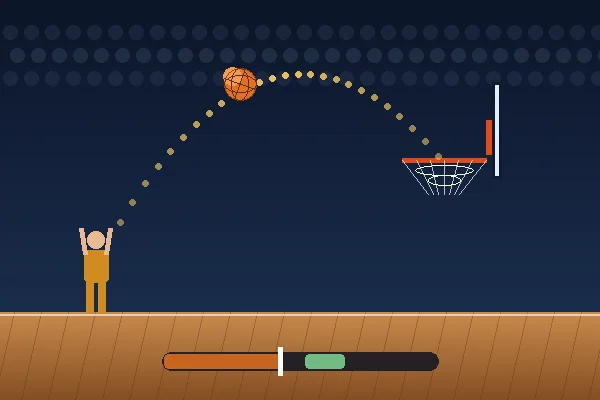
Hold to charge, release inside the window, and keep the combo alive by never letting the pace drop.
 Featured
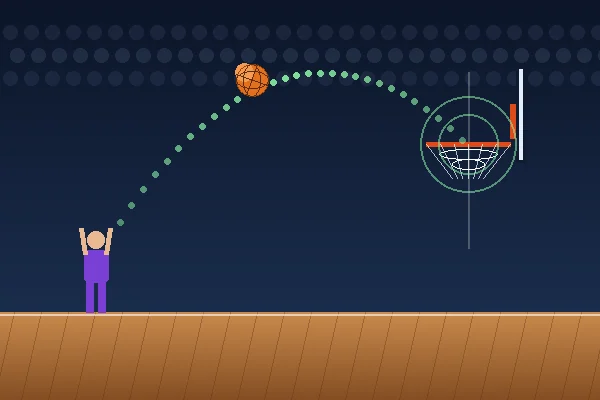
The flight path is drawn for you before every shot. The hoop is what makes it hard — it drifts, then it drifts faster.