Basketball Shooting Games
Basketball Shooting Games: A Complete Beginner’s Guide
The three control schemes you will meet, what each one is really testing, and what to practise first.
Shooting games are where most people enter the genre, and where most people form the habits that later limit them. This guide is about starting with the right ones.
The three control schemes
Almost every basketball shooting game uses one of three arrangements. Identifying which one you are playing tells you immediately what the game is testing.
Scheme 1: You control both angle and power
The most intuitive and, counter-intuitively, the hardest to learn from — because when a shot misses, either variable could be the cause.
You will usually aim by dragging, with direction setting the angle and distance setting the power. Basketball Shooting Challenge works this way.
What it tests: combined judgement of arc and distance.
The trap: changing both variables after every miss, which makes the result unattributable. Fix the angle, vary only power, and you will improve far faster.
Scheme 2: Fixed angle, variable power
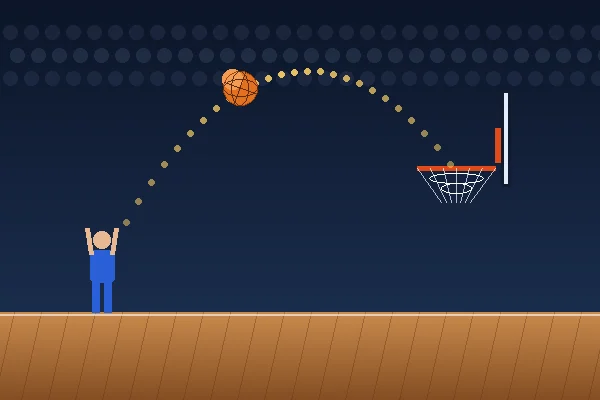
The angle is set by the game — 56 degrees in the 3-Point Challenge, 58 in Basketball Time Attack — and you choose power, usually by stopping a meter or releasing a charge.
What it tests: distance reading, and nothing else.
The trap: trying to learn "the right point on the meter". There is no single right point, because the correct power depends on the current distance. What you are actually learning is a mapping from distance to meter position.
Scheme 3: Fixed power, sweeping angle
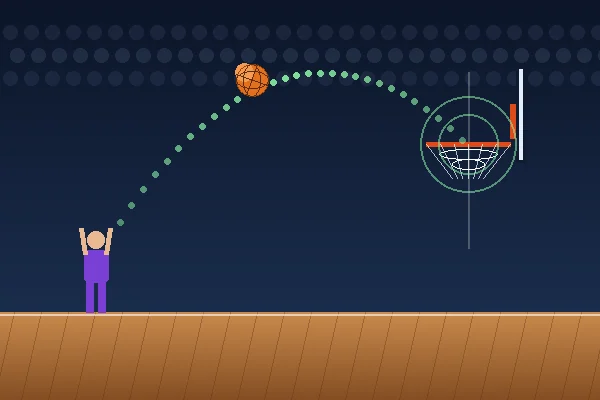
The rarest and, for beginners, the friendliest. Power is constant; the release angle sweeps up and down and you choose when to let go. Basketball Precision Shot works this way and draws the resulting flight path on screen.
What it tests: timing and anticipation.
Why it is a good starting point: it removes the invisible variable. You are not estimating physics, you are reading a line.
What to practise first
Week one: arc. Play Precision Shot and pay attention to the shape of the previewed line at different angles. You are building a mental picture of what a good shot looks like from a given distance.
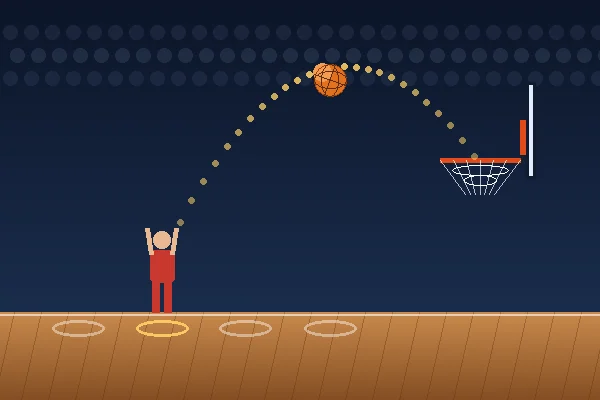
Week two: power. Move to the 3-Point Challenge, where angle is fixed and power is everything. Use the ghost marker the game leaves after each make as your reference when you move between spots.
Week three: both. Basketball Shooting Challenge. Now you have both halves and a relocating rim that stops you from coasting on memory.
This order is deliberate. Learning power before arc means guessing at two things at once.
The single most common mistake
Over-powering. It is nearly universal, and it happens for an understandable reason: when a shot falls short, adding power fixes it, so "more power" becomes the default response to any miss — including the long ones.
If most of your misses sail past the hoop, ease off more than feels right. Beginners consistently under-correct because the shot that goes long still looks closer to correct than the one that falls short.
Reading a miss
Where the ball ends up tells you what went wrong. This is the most useful habit in the genre.
| Where it landed | What it means | Fix |
|---|---|---|
| Past the hoop, high off the board | Too much power | Reduce power noticeably |
| Front rim, dropping short | Too little power | Add power |
| Back rim, arriving flat | Arc too low | Raise the release angle |
| Right distance, hoop had moved | Timing, not shooting | Lead the target |
That last row only applies in games with a moving hoop, and it is a different problem entirely — see how to master timing.
What a normal progression looks like
- First session: 30 to 45 per cent on a fixed-angle game. Completely ordinary.
- After a couple of sessions: mid-50s, once over-powering stops.
- After that: slow gains that come from consistency rather than insight.
These numbers are only meaningful against your own past sessions on the same game. A percentage in one game says nothing about another, because the rim size, the distances and the tolerances all differ.
Two things that are not your fault
The hoop moving. Most games here relocate the rim after every shot. This is deliberate design, not you failing to memorise something. Read the new position before you aim.
Difficulty rising. The rim gets smaller and further away as your streak grows in Basketball Shooting Challenge, and the meter speeds up each lap in the 3-Point Challenge. Missing after a good run is often the game changing, not you getting worse.
Your first ten minutes, shot by shot
Rather than general advice, here is what a good first session actually looks like.
Shots 1–5. Do not try to score. Take five shots at deliberately different power levels — very soft, soft, medium, hard, very hard — and watch where each one lands. You are establishing the range of the control, which is information you cannot get by trying to be accurate.
Shots 6–10. Now aim. Use what you learned. Expect roughly one or two to go in.
Shots 11–20. Pick the direction of your dominant error and correct only that. If most are long, reduce power and keep it reduced even after a short miss — one short miss does not mean you over-corrected.
Shots 21–30. Hold whatever you settled on. Do not change anything. You are now measuring rather than exploring, and the percentage across these ten is your actual starting point.
That is about three rounds of a sixty-second game. It is a more useful ten minutes than thirty minutes of playing normally, because at the end of it you know something specific.
Telling a fair shooting game from an unfair one
Not all browser basketball games are worth your time, and the test takes about a minute.
Take the same shot twice. If a game lets you repeat an identical input — same power, same angle, same distance — do it. In a fair game the result is identical. If it is not, the game is applying hidden randomness, and no amount of practice will help.
Miss on purpose, long. A fair game will show the ball sailing past the rim, which tells you the error. An unfair one shows something ambiguous.
Check whether the rim is a real object. Shoot at the rim edge. If the ball bounces convincingly, the game models collision. If it either passes through or stops dead, it does not, and the game is really a hit-or-miss check dressed as physics.
Look for a backboard. A modelled backboard is a sign of care, and it gives you a genuinely wider target.
Games on this site pass all four, which is not a boast so much as the baseline we would want before writing guides claiming that practice works.
What "fixed angle" really changes
Beginners often assume a fixed-angle game is a simplified version of a full-control one. It is closer to the opposite.
With two variables, a miss is ambiguous but you have somewhere to hide — a bad power reading can be partly rescued by a better angle, and you can find a combination that works without understanding either variable.
With one variable, there is nothing to hide behind. Every miss is a power error, full stop. That makes the game harder to score well in and much easier to learn from, which is why the four-week structure in our accuracy guide puts fixed-angle practice before full-control practice.
If you are struggling with drag-to-aim, the fastest route is not more drag practice. It is a week of fixed-angle games to build the distance-to-power mapping, then a return.
The three distances worth learning first
In games with a relocating rim, you are not learning a continuum, you are learning anchors.
Close. Roughly the nearest third of the court. Worth two points in the games that vary by distance. The setting here is the one you should be most confident in, because it comes up most.
Mid. The middle third. The one most players are weakest at, because it is neither the default nor the special case.
Deep. Beyond the marker that switches the shot to three points. Worth learning precisely because the extra point makes it worth taking — but only once you can make it reliably enough.
Learn close first until it is automatic, then deep, then mid. Mid comes last because by the time you have anchors either side of it, interpolating is much easier than learning it cold.
Where to go next
— the detailed version of everything above.
- Basketball shooting game tips — twelve specific
techniques.
- All shooting games — the full category.
Frequently asked questions
What is the easiest basketball shooting game for a beginner?
One that previews the shot. Basketball Precision Shot draws the ball’s flight path before you release, which lets you learn what a correct arc looks like rather than inferring it from misses.
Why do I keep shooting over the hoop?
Too much power — by a distance the most common beginner error. Reduce it more than feels right, or raise your release angle and keep the power the same.
What is a good shooting percentage in an arcade game?
It depends entirely on the game, so it is only meaningful against your own past numbers. On a fixed-angle game, a first session around 30 to 45 per cent is normal, and most players reach the mid-50s fairly quickly once they stop over-powering.
Do I need a mouse to play shooting games?
No. Every shooting game here works with the keyboard alone, with touch, or with a mouse. Drag-to-aim games are a little more comfortable with a pointer, but nothing requires one.