Basketball Shooting Games
Basketball Shooting Game Tips That Actually Work
Twelve specific, tested techniques for shooting games — with the reasoning behind each one, not just the instruction.

This is a list, but every item has a reason attached. Tips without reasoning are impossible to adapt when the game changes, and arcade games change constantly.
All twelve were tested in the shooting games on this site.
1. Set your arc once, then leave it alone
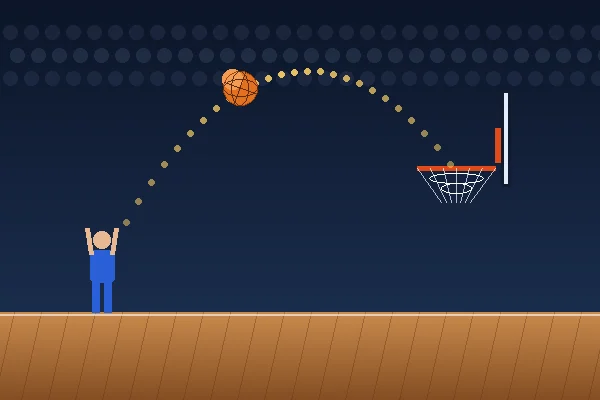
When you can control both angle and power, the temptation is to adjust both on every shot. Resist it. Pick a steep-ish angle you are comfortable with — somewhere around 50 to 60 degrees — and vary only power until your distance judgement is solid.
Why: with two variables in play you cannot attribute a miss to either one. One variable at a time is the only way to learn anything.
2. Read the distance before you touch the controls
In Basketball Shooting Challenge the floor shows whether the current shot is worth two points or three, which is a direct readout of distance. Look at it first. Aiming and then noticing you are shooting from deep is how over-powered shots happen.
3. Use the backboard on purpose
The backboard on these games is a real collision surface, not scenery. That means a shot that is slightly long can bank in — which makes "aim at the board" a genuinely larger target than "aim at the rim".
Why it matters: the rim opening is a few tens of pixels wide. The board is much bigger. If you are missing long consistently and cannot seem to dial it back, aim deliberately at the board and let the bounce do the work.
4. Treat the first shot after any change as calibration
New rack, new lap, new difficulty tier, hoop moved further out — the first shot after any of these is information, not points. Take it, watch where it lands, adjust.
Players who expect to score on that shot end up making two errors: the miss itself, and the overcorrection that follows.
5. Protect a high streak with easy shots
Streak multipliers cap, but they reset to zero instantly. Once you are at or near the cap, the value of any individual shot is at its highest — which is exactly when a risky shot costs the most.
Concretely: at a x4 multiplier in Basketball Shooting Challenge, a two-point make is worth eight. A miss costs you that and every multiplied point on the shots that follow while you rebuild.
6. Learn what your misses sound like
The games here play a different sound for a clean make, a rim contact and a miss. That is feedback arriving slightly before you have visually processed the result, and it is genuinely useful for pacing your next input.
If you play with sound off, you are throwing away a channel of information for no benefit.
7. On fixed-angle games, learn the spots, not the meter
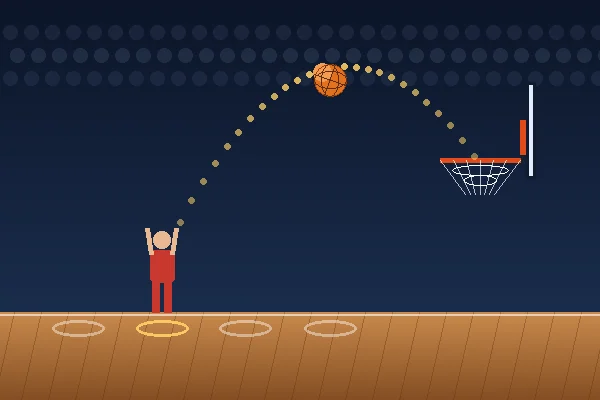
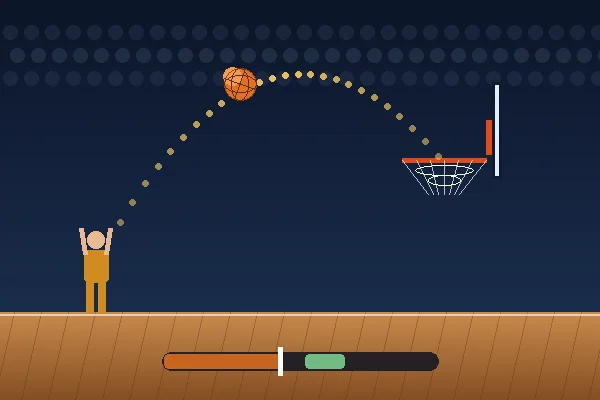
In the 3-Point Basketball Challenge each of the five positions has its own correct power. Trying to learn "the meter" is a category error — there is no single correct point on it.
Use the ghost marker the game leaves after each make as your reference, and adjust relative to it when you move.
8. Shoot the money ball with a rhythm you already have
The last ball of each rack in the 3-Point Challenge is worth more. The instinct is to take extra care over it, which breaks the rhythm that was making you accurate.
Better: shoot it exactly like the previous four. The extra value comes free if you simply do not change anything.
9. Under a clock, do not let one miss become three
A miss under time pressure produces a predictable spiral: frustration, rushed release, second miss, bigger rush. The round is usually lost in the ten seconds after the first miss rather than in the miss itself.
The counter is mechanical: after any miss, deliberately take one slow shot. It costs about a second and it resets the rhythm.
10. Late in a round, take the valuable shot
The advice to protect your combo reverses in the last few seconds. With not enough time left for a multiplier to compound, the highest-expected-value shot is simply the highest-value one available.
In Basketball Time Attack, that means taking the deep shot at the buzzer even if your success rate from there is mediocre.
11. Do not restart a round that started badly
Two reasons. First, a bad start is recoverable in every timed game here — sixty seconds is a long time and multipliers rebuild quickly. Second, restart-spamming means you only ever practise the first ten seconds, which is the part you are already best at.
12. Finish while you are still good
Shooting accuracy in these games falls off with fatigue before you notice it subjectively. If your last two rounds were worse than the three before them, that is not a slump you can push through — it is the end of the useful session.
Three tips you will read elsewhere that do not hold up
"Aim for the back of the rim." This comes from real basketball coaching, where a real ball behaves differently off a soft rim and a slightly deep shot has a genuine chance of dropping. In a 2D arcade game the rim is two collision circles and the most common miss is already long. Following this advice makes the dominant error worse.
"Turn the sound off to concentrate." The games here use distinct audio for a clean make, a rim contact and a miss. That is information arriving slightly before your eyes have processed the result, and losing it makes your next input marginally later. If sound is distracting, that is a fair reason to mute it — but it is a cost, not a benefit.
"Warm up with a few throwaway rounds." Warming up is real, but throwaway rounds are not warm-up, they are unfocused play. One round spent watching where misses land does more than three rounds spent not caring.
A one-round diagnostic
Sixty seconds that will tell you what to work on.
Play one round of Basketball Shooting Challenge and, after each attempt, silently label the miss: long, short, flat, or made. Do not change anything during the round.
Then read the pattern:
| What you saw | What it means | What to do next |
|---|---|---|
| Mostly long | Over-powering — the most common pattern by far | Reduce power more than feels right |
| Mostly short | Under-powering, usually from over-correcting a previous session | Add power, and stop correcting after single misses |
| Mostly flat back-rim | Arc too low | Raise your release angle into the 50–60° band |
| Roughly even split | Consistency, not calibration | Work on rhythm: release on a count, not on a feeling |
| Mostly made, misses scattered | You are fine — go and play a harder game | Move to the 3-Point Challenge |
The value here is that four of those five rows lead to different actions. Practising without knowing which row you are in means picking one at random.
Tips specific to a moving rim
Three of the six games here relocate the hoop between shots, and one moves it continuously. That changes a few things.
Look before you aim, every single time. The single most common cause of a wild miss is aiming from memory of the previous shot.
Prefer the vertical read. When the rim has moved both further away and higher, the height change is the larger effect over the ranges these games use. Adjust for it first.
With a continuously moving hoop, wait rather than lead when you can. In Basketball Precision Shot there is no clock, so waiting for the rim to pause at the top or bottom of its travel costs nothing and removes the hardest part of the problem.
With a rim that relocates between shots, the first shot from a new position is information. Not a failure. Budget for it.
Where to practise each of these
| Tip | Best game to practise it in |
|---|---|
| Arc control | Basketball Precision Shot |
| Distance reading | Basketball Shooting Challenge |
| Power meters and spots | 3-Point Basketball Challenge |
| Pacing under a clock | Basketball Time Attack |
For the reasoning underneath these tips, the longer read is how to improve your arcade shooting accuracy.
Frequently asked questions
What is the quickest way to get better at shooting games?
Stop changing two things at once. Fix your arc at a steep, comfortable angle and vary only power until your distance judgement is reliable, then start varying arc again.
Do bank shots work in arcade basketball games?
In games with a modelled backboard, yes. On this site the backboard is a real surface the ball bounces off, so a slightly long shot can drop in off the board. That makes an intentional bank shot a genuinely wider target than aiming for the rim alone.
Why does the hoop keep moving?
To stop a single memorised input from working. In Basketball Shooting Challenge the rim relocates after every attempt and moves further away as your streak builds, which is why reading the distance marker before aiming matters more than muscle memory.