Basketball Shooting Games
Best Three-Point Shooting Games to Play in Your Browser
What separates a good three-point game from a bad one, how rack formats work, and how to score well in them.

Three-point games are the most structured corner of the shooting genre, and the structure is what makes them good. A generic shooting game can drift; a rack format has a rhythm built into it.
What separates a good one from a bad one
It varies the distance. This is the whole test. A game that puts you at one distance and adds a clock is not a three-point game, it is a timed shooting game with a longer shot. The skill in distance shooting is recalibration, and you cannot practise recalibration without something to recalibrate to.
It gives you a reference. Good games leave some trace of your last successful shot — a marker, a readout, anything. Without one, moving to a new spot means guessing from nothing, which is not skill, it is chance.
It fixes one variable. The best three-point games fix the release angle so power is the only thing you control. That sounds like a simplification; in practice it sharpens the game, because every miss now has exactly one possible cause.
It rewards a full rack. Streak bonuses that build within and across racks give the format its arc — a good rack should feel like it is compounding.
How the rack format works
Five balls from one spot, then move. Repeat across several positions at different distances, against a clock.
The design does two things at once. It creates a rhythm — five shots is long enough to settle into one — and it repeatedly breaks that rhythm by moving you. That tension is the game.
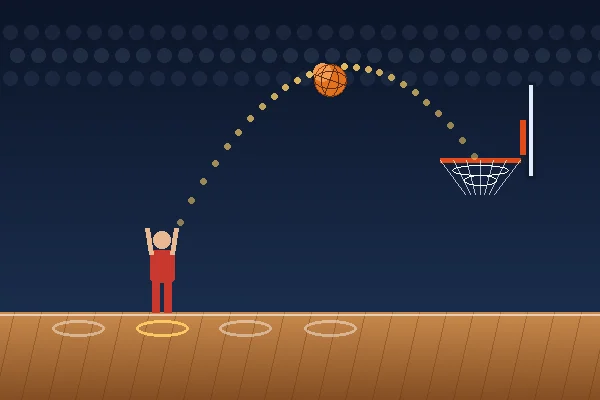
On this site, the 3-Point Basketball Challenge uses five spots labelled corner, wing, top of the key, wing and deep corner, at increasing distance. The last ball of each rack is worth three points instead of two, and once you are three makes into a streak every make earns one extra point on top.
Complete all five racks and the game starts over with a faster meter and a slightly smaller rim.
Scoring well: it is a mapping problem
Here is the reframe that helps most people.
You are not trying to "shoot better". You are trying to learn a lookup table: five distances, five correct meter positions. Once you have the table, shooting is execution.
That changes what practice looks like:
- Spend a rack learning, not scoring. The first shot from a new spot tells you which side of
correct you are on. Use it.
- Adjust in one direction. If you missed long, release earlier — and keep releasing earlier
until you miss short. Alternating around the target teaches nothing.
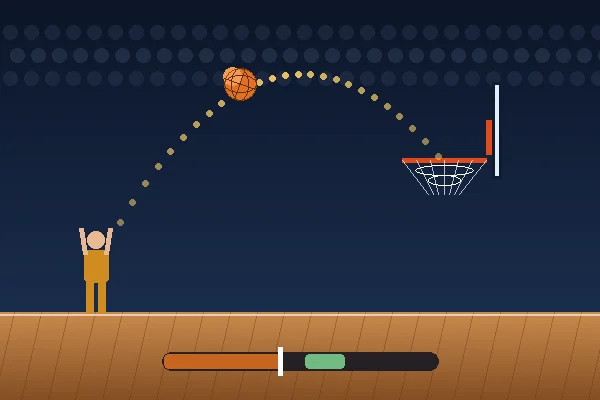
- Use the ghost marker. The dashed line left on the meter after each make is your reference
point. Adjust relative to it rather than guessing absolutely.
The money ball trap
The last ball of each rack is worth more, and almost everyone responds by taking extra care over it.
That is precisely the wrong move. The extra care breaks the rhythm that made the previous four accurate, and a broken rhythm costs more than the bonus is worth.
Shoot the money ball exactly like the other four. The bonus is free if you simply do not change anything.
Streaks compound across racks
A detail worth exploiting: the streak bonus in the 3-Point Challenge does not reset when you move spots. Only a miss resets it.
That means a streak carried into a new rack is worth considerably more than one started inside it — every make at the new spot is already earning the bonus. The practical consequence is that the last ball of a rack and the first ball of the next one are the two most valuable shots in the game, and they sit either side of the moment you are most likely to miss.
Treat the transition between spots as the high-stakes moment, not the money ball.
The lap problem
Complete all five racks and the meter speeds up. A rhythm learned at lap one speed is wrong at lap two speed.
Expect it. Budget the first shot of each new lap for recalibration and you will lose one shot; refuse to and you will usually lose three, because the first miss produces an overcorrection and the overcorrection produces another.
Practising distance shooting elsewhere
Three-point shooting is a specific case of distance judgement, which you can also build in Basketball Shooting Challenge — there the rim relocates continuously rather than in five fixed positions, which is harder but teaches the general skill rather than five specific answers.
Basketball Time Attack sits between the two: the hoop moves after every shot, but the game draws the correct power window for the current distance, so you can see the mapping you are supposed to be learning.
Why the real format translates so well
The rack structure is borrowed almost unchanged from real-world shooting contests, and it is one of the few cases where a real sporting format maps cleanly onto an arcade game.
Real contests work because they combine three pressures that are individually mild and jointly difficult: a clock, a fixed number of attempts per position, and positions at different distances. None of that needs adaptation to become a video game — it is already a scoring system.
What the digital version adds is precision. In a real contest, distance judgement is handled by your body and years of practice. In an arcade version, it becomes an explicit control problem: this distance requires this meter position, and you either know it or you do not.
That explicitness is what makes the format so good for learning. You can see your calibration working or failing, shot by shot.
What a better rack format would do
Three improvements worth wanting in any three-point game.
Show the distance numerically. Most games, including ours, indicate distance visually. A number would let a player build an explicit mapping rather than an intuitive one, which is faster to learn and easy to turn off for players who prefer the intuition.
Let you replay a single spot. A practice mode that stays at one position until you choose to move would let players work on their weakest distance rather than encountering it once every twenty shots.
Show the miss margin. Not just "miss" but "long by a little". The information is available to the game; showing it would collapse the learning curve.
None of these is exotic. They are absent from most games in the format because the format was inherited from a contest rather than designed as a teaching tool.
Scoring maths for the format
A quick calculation that changes how the last ball feels.
In the 3-Point Basketball Challenge, a regular make is 2, a money ball is 3, and once you are three makes into a streak every make earns an extra point.
A perfect rack — five makes with a streak already running — is:
3 + 3 + 3 + 3 + 4 = 16 points
A rack with one miss on the second ball, breaking a running streak:
3 + 0 + 2 + 2 + 3 = 10 points
One miss costs six points out of sixteen in a five-shot rack, and most of the loss is not the missed shot itself — it is the streak bonus disappearing from the three shots after it.
Across a full sixty seconds, that difference compounds into most of the gap between an average score and a good one.
Practising distance without the clock
The 3-Point Challenge is a timed game, which makes it a poor place to learn even though it is a good place to test.
A better sequence:
Learn the mapping in Time Attack. Basketball Time Attack draws the correct power window on the bar for the current distance. Play a few rounds simply watching where the window sits at different distances — you are being shown the mapping the 3-Point Challenge expects you to have memorised.
Build judgement in Shooting Challenge. Basketball Shooting Challenge has a continuously relocating rim and full manual control, which builds general distance reading rather than five specific answers.
Then test in the 3-Point Challenge. With both of those in place, the five spots stop feeling like five separate problems.
Where to go next
- 3-Point Basketball Challenge — the game this article is
about.
- Basketball shooting game tips — twelve techniques,
several specific to meters.
Frequently asked questions
What is a rack in a three-point shooting game?
A group of balls shot from one position before moving to the next. It comes from real-world shooting contests, and in games it exists to force you to recalibrate for a new distance every few shots.
What is a money ball?
A specific ball worth more than the others — usually the last of a rack. In the 3-Point Basketball Challenge on this site it is worth three points instead of two.
How do I shoot better from distance?
Treat it as a mapping problem rather than a skill problem. The correct power for each spot is a fixed number; your job is to learn five numbers, not to shoot harder. Use the ghost marker left after each make as your reference.
Why do I make the first rack and miss the second?
Because you carried the power setting across. Each spot is a different distance and therefore a different correct power. Treat the first shot at every new spot as a calibration shot.