Basketball Arcade Guides
The Ultimate Guide to Basketball Arcade Games
The whole genre in one place — sub-genres, the skills behind them, and a structured path from your first round to a score you are proud of.
This is the long version: what the genre is, how it divides, what each part asks of you, and a sequence for getting good at it rather than merely playing a lot of it.
If you want the short version, the beginner’s guide is twenty minutes rather than twenty pages.
What makes a game an arcade basketball game
Three properties, and a game needs all three.
Short sessions. A round lasts seconds to a couple of minutes. There is no save file, no season, no progression that requires commitment.
Simple input. One or two controls, learnable in seconds. Depth comes from when and how much, not from the number of buttons.
Immediate, legible feedback. You know instantly whether you succeeded, and — in a well-built one — why. That legibility is the genre's defining quality and the thing that separates a good arcade game from a frustrating one.
Notice what is not on the list: realism, teams, players, licences. Those belong to a different genre, covered in arcade versus simulation.
The five sub-genres
Shooting games
The purest form. A hoop, a distance, a release. Variations differ in what they let you control:
- Full control — you set both angle and power.
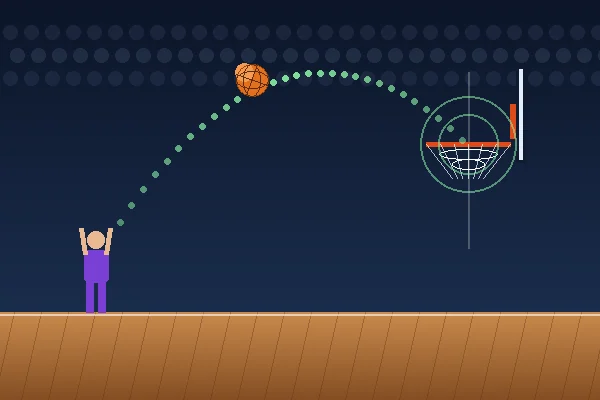
(Basketball Shooting Challenge)
- Fixed angle — only power varies, usually through a meter.
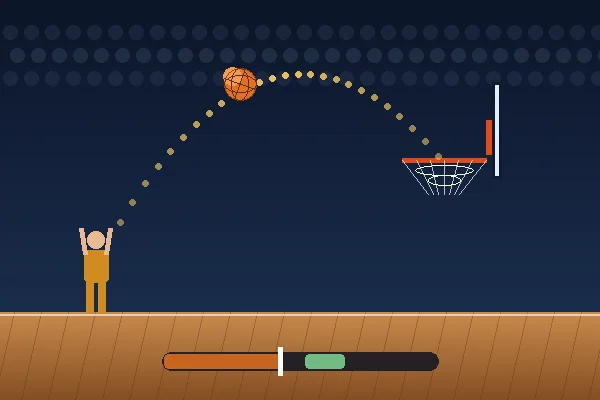
(3-Point Basketball Challenge)
- Fixed power — only the angle varies, usually sweeping automatically.
Each removes a variable to sharpen the remaining one. Fewer variables usually means a harder game, not an easier one, because there is nowhere to hide.
Trains: distance judgement, arc control, calibration.
Dunk and finishing games
Distance stops mattering; timing takes over. You are close to the hoop and the question is when to leave the floor. (Dunk Challenge)
Trains: anticipation, rhythm, commitment.
Endless and runner games
No finish line. The game accelerates until you fail, and the score measures survival. (Basketball Hoop Rush)
Trains: sustained attention, small corrections, risk management under rising pressure.
Timed score attacks
A fixed window and a question: how much can you do in it? (Basketball Time Attack)
Trains: pacing, decision-making under pressure, the accuracy-versus-volume trade-off.
Skill and precision challenges
Scoring rewards how well, not merely whether. Accuracy grades, centring bonuses, combo systems that pay for consistency.
Trains: precision, patience, the discipline to wait for a better opportunity.
What actually transfers between games
This is worth being precise about, because assuming too much transfer is a common cause of frustration.
Transfers well:
- Arc judgement. The shape of a good shot is similar across games with similar physics.
- Anticipation. The habit of choosing a release point in advance rather than reacting is
universal.
- Scoring literacy. Once you understand combo multipliers, you read every new game faster.
- Pacing discipline. Knowing that rushing costs more than it gains applies everywhere.
Transfers poorly or not at all:
- Specific power values. Every game maps its meter to a different speed range. Carrying a number
across is worse than starting fresh.
- Muscle memory for a particular meter. Speeds differ, and often change within a single game.
- Confidence. Being good at one sub-genre says surprisingly little about another.
A structured path
Random play produces slow, uneven improvement. This sequence is faster.
Stage 1 — See a correct shot (10 minutes)
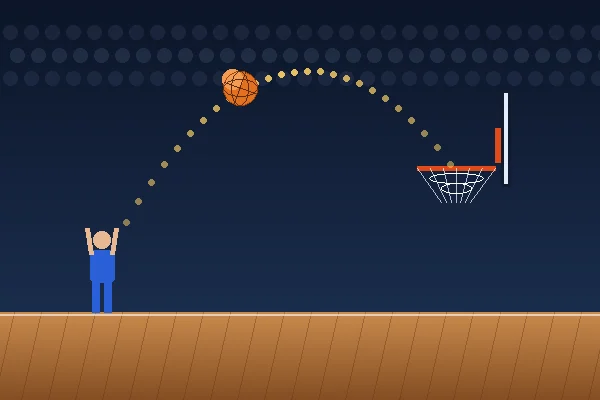
Play Basketball Precision Shot. The flight path is drawn for you; your only job is to notice what different angles produce.
Stop when: you can predict where a shot will land before you release.
Stage 2 — Reproduce it (20 minutes)
Move to Basketball Shooting Challenge. Same physics, but now you set both variables and the rim relocates every attempt.
Fix your angle somewhere steep and vary only power until distance judgement is reliable.
Stop when: you are over about 50 per cent across three full rounds.
Stage 3 — Learn a meter (20 minutes)
Move to the 3-Point Challenge. The angle is fixed; power is everything; the five spots are five different answers.
Use the ghost marker the game leaves after each make as a reference point.
Stop when: you can move between spots without a calibration miss each time.
Stage 4 — Add pressure (20 minutes)
Basketball Time Attack. Everything you have built, plus a clock and a combo that decays.
This is where pacing becomes the skill rather than shooting.
Stop when: your slow rounds outscore your fast rounds — which means you have found the trade-off.
Stage 5 — Branch out (ongoing)
Dunk Challenge and Basketball Hoop Rush exercise timing and rhythm rather than aiming. They are the variety that keeps the practice from going stale.
Reading a scoring system
Before optimising anything, answer four questions from the game's own rules:
- What is the base value of a success?
- What raises it? (Distance, accuracy, position, streak.)
- What resets it? (A miss? A timer? Both?)
- What ends the run? (Clock, lives, collision.)
Those four answers determine the correct strategy completely. A game with a decaying combo wants speed; a game with lives and no clock wants patience. Using the wrong one costs more than poor execution does.
There is a full treatment in how to get higher scores.
Realistic expectations
Improvement in this genre has a shape:
- First twenty minutes: large gains. You are learning rules and controls.
- Next hour or so: a plateau, often frustrating. Calibration is catching up quietly.
- Then a jump: usually triggered by one insight — waiting for the turning point, taking the
layup, slowing down under a clock.
- After that: slow, steady gains from consistency alone.
The plateau is where most people conclude they have found their level. They usually have not; they are one insight short, and the insight is normally something specific about the game rather than something general about themselves.
Common mistakes, in order of cost
- Playing six games in a session. Calibration is game-specific. Pick one.
- Rushing under a clock. Costs more accuracy than it gains attempts, every time.
- Adjusting after every shot. You cannot measure a change you did not repeat.
- Taking difficult shots to protect a streak. Backwards — a high multiplier makes the safe shot
more valuable, not less.
- Ignoring the scoring rules. Five minutes of reading beats an hour of guessing.
- Pushing through fatigue. Timing degrades before you notice, and practising while degraded
teaches the degraded version.
Where the genre came from
A short history, because it explains why these games look the way they do.
The cabinet era. Physical basketball arcade machines — a real ball, a real hoop, a timer and a ticket dispenser — established the template that digital versions still follow: a short fixed period, a score, and immediate replayability. The sixty-second round is not an arbitrary choice; it is inherited.
The Flash years. From the late 1990s through to around 2020, browser gaming meant Flash, and basketball was one of its staple genres. Thousands of small shooting games appeared, most built by individuals, most sharing a handful of mechanics. The good ones established conventions still in use: the power meter, the drag-to-aim slingshot, the rack format.
The gap. Flash never ran on iOS, and Adobe discontinued Flash Player at the end of 2020. A large amount of casual gaming history became unplayable, and the mobile web spent years with very little to offer.
HTML5 and Canvas. The replacement was not a plugin but a set of standards built into the browser itself. The practical consequence was that browser games could finally run on phones, which changed what the genre optimised for: one-button controls, portrait layouts, sessions measured in seconds.
That last shift explains most of what is distinctive about modern browser basketball games. They are designed for a thumb.
Design patterns worth recognising
Once you can name these, you can read a new game in about thirty seconds.
The sweeping meter. A value oscillates automatically and you stop it. Converts an analogue judgement into a timing decision, which is why it survived the move to touchscreens intact.
The slingshot. Drag back or forward to set direction and magnitude in one gesture. The most expressive input in the genre and the hardest to learn from, because two variables mean a miss has two possible causes.
The charge. Hold to build power, release to act, with the meter falling back if you hold too long. Punishes indecision directly.
The fixed arc with a variable start. Used by dunk and jump games. The player controls one thing: when the arc begins.
The scrolling gate. Endless-runner structure: a continuous obstacle stream with a single corrective input. Not basketball-specific at all, which is why it transplants so easily.
The rack. A group of attempts from one position before moving on. Borrowed from real shooting contests, and it survives because it creates and then deliberately breaks a rhythm.
Graded success. Scoring the quality of an outcome rather than its occurrence. The most effective single mechanic for making a simple game deep.
Judging a new game in sixty seconds
A checklist you can run on any basketball game you find anywhere.
Seconds 0–10: does it start? Page load to first input. Anything longer than a couple of seconds, or any account prompt, tells you what the site is optimising for.
Seconds 10–20: can you tell what to do? A one-line instruction or an obvious control. If you need a tutorial for a one-button game, the game is not confident in itself.
Seconds 20–40: fail on purpose. This is the important one. Miss deliberately and see whether the game tells you why. A game that says only "miss" cannot be learned.
Seconds 40–50: is difficulty visible? Succeed a few times and watch whether anything on screen changes. Invisible escalation reads as cheating.
Seconds 50–60: check the phone case. Even on desktop, resize the window. A playfield that letterboxes or crops was built before mobile mattered.
A game that passes all five is worth twenty minutes. One that fails the twenty-to-forty second test is not worth ten.
Quick reference
The vocabulary used throughout this site, compressed. The full version is the terminology guide.
| Term | Means |
|---|---|
| Arc | The curve of the shot. Steeper is more forgiving. |
| Window | The span of time or distance an input can fall in and still count. |
| Tolerance | The same idea expressed as "how wrong can I be". |
| Combo | Consecutive successes. |
| Multiplier | The number your score is multiplied by, driven by the combo. |
| Decay | A combo that expires on a timer rather than only on a miss. |
| Graded success | Scoring how well you succeeded, not just whether. |
| Rack | A group of attempts from one position. |
| Lap | One full cycle through all the content, usually harder each time. |
| Tier | A difficulty step. |
| Endless | No finish line; the score measures survival. |
Where the difficulty actually comes from
A useful mental model for any game in the genre: difficulty is made of exactly four ingredients, and every game is a recipe.
- Tolerance — how precise the input must be.
- Speed — how much time you get to produce it.
- Variation — how much the situation changes between attempts.
- Cost — what a failure takes away.
The games here mix them differently. Precision Shot is high variation, low cost. Time Attack is high speed, tightening tolerance. Hoop Rush is rising speed with total cost. Dunk Challenge tightens tolerance and raises speed together while holding cost at three lives.
Once you can see which ingredient is hurting you, you know which habit to change — and it is usually not "get better at the game".
Where to go from here
- How basketball arcade games work — the systems
underneath.
the most practical single guide on the site.
- High score strategies by game type — matching
strategy to format.
- The game directory — everything, filterable.
Frequently asked questions
What is a basketball arcade game?
A short-session basketball game built around one or two simple inputs, immediate feedback and a score, rather than around teams, seasons or simulation. Rounds usually last under two minutes and the rules can be learned in seconds.
How is an arcade basketball game different from a basketball simulation?
An arcade game simplifies deliberately so that the player can predict what will happen. A simulation tries to reproduce what really happens, including the parts that are hard to predict. Different goals, not different levels of quality.
What skills do basketball arcade games actually build?
Arc and distance judgement, anticipation rather than reaction, rhythm under pressure, and risk assessment when scoring systems offer a choice. They do not build real-world basketball skill.
How long does it take to get good?
Most players see a large jump within the first twenty focused minutes on a single game, then a plateau, then a second jump when one specific insight lands. Progress is not linear, and the plateau is normal rather than a ceiling.
References
External sources used in this article. Game mechanics described above come from the games’ own rules, which are documented on each game page.
- Canvas API — MDN Web Docs — The browser technology every game on this site is built with.
- Reaction time — Encyclopaedia Britannica — Background on the latency that makes anticipation necessary.