Basketball Challenge Games
Casual Basketball Games: Easy to Start, Hard to Put Down
"Casual" describes how a game starts, not how deep it goes. Which basketball games get that balance right.

"Casual" is one of the least useful words in games writing, because it is used to mean both "welcoming" and "shallow", and those are completely different properties.
The useful definition: a casual game is one with no prerequisites. No vocabulary to learn, no manual to read, no prior experience assumed. What happens after the first minute is a separate question entirely, and the best casual games have a great deal happening there.
The ten-second test
Here is the practical standard. A casual game should produce a small success within about ten seconds of a first-time player arriving.
Not a win. A success — one hoop cleared, one basket made, one moment of "oh, I see". That early success is what buys the game permission to be hard afterwards.
Games that fail this test fail for predictable reasons: a tutorial before the game, a control scheme that needs explaining, or a difficulty floor set where the designer's own skill sits rather than where a newcomer's does.
Which games here qualify
Basketball Hoop Rush — the most casual
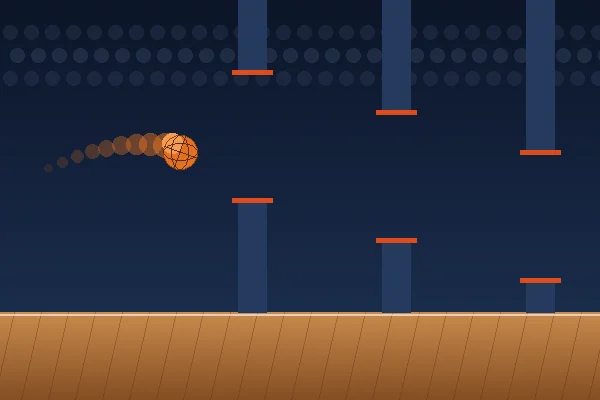
The rule is "tap to bounce, go through the hoops". That is the entire explanation, and almost everyone clears at least one hoop on their first attempt.
Underneath, it is not shallow at all — the speed climbs continuously, the openings narrow, and past twenty hoops some start drifting vertically. A good run requires sustained small corrections and a genuine decision about whether to chase the centring bonus. But none of that is in your way at the start.
Basketball Precision Shot — the calmest
Play Basketball Precision Shot
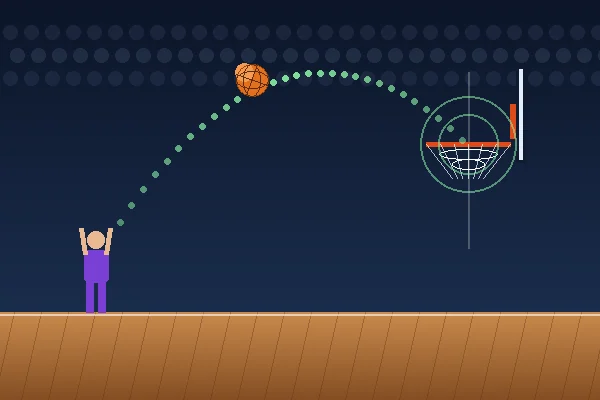
One button, no clock, and the game draws the ball's flight path before you release. First-time players usually make their first shot, because the game has told them when to press.
The depth arrives quietly: accuracy grading means a shot that scrapes in is worth 6 points where a centred one is worth 15, and a combo multiplier up to x5 means consistency compounds. You can play it without engaging with any of that, and you will still have fun.
Dunk Challenge — casual with a hook
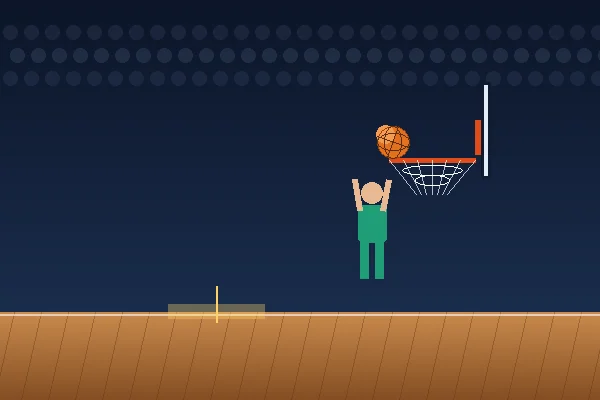
One button for the main action, and a band drawn on the floor telling you where to press. Most people finish their first dunk within a few attempts.
It is slightly less casual than the two above because the brake and sprint controls add something to learn — but they are entirely optional for the first several rounds.
Less casual: the timed games
Basketball Time Attack and the 3-Point Challenge put a clock on you immediately, and Basketball Shooting Challenge asks you to manage two variables at once. All three are excellent; none is where a first-time player should start.
The design trick: difficulty that waits
The property that lets a casual game be deep without being a wall is difficulty tied to success rather than to time.
Compare two designs:
- Difficulty rises every thirty seconds. A struggling player gets a harder game while still
failing at the easy one. Brutal.
- Difficulty rises every time you succeed. A struggling player stays at the level they are
working on; a strong player reaches the interesting part quickly.
Every game on this site uses the second. The rim in Basketball Shooting Challenge moves further out as your streak grows. The meter in the 3-Point Challenge speeds up when you complete a lap. Dunk Challenge tightens its window each cleared round.
The effect is that the game meets you where you are, without a difficulty menu and without anyone having to describe themselves as a beginner.
Casual does not mean no-skill
Worth saying plainly, because the word carries an unfortunate implication.
A one-button game with a narrow timing window is one of the most demanding things in gaming, because there is exactly one thing to get right and no way to compensate elsewhere. The skill ceiling in Hoop Rush is high — clearing fifty hoops requires sustained precision under continuously rising speed.
What "casual" removes is the barrier, not the ceiling.
Why casual games often have the best design
An observation that surprises people: the most carefully designed games are frequently the simplest ones.
The reason is that complexity hides problems. A game with twelve systems can be mediocre at all of them and still occupy you, because there is always something else to engage with. A game with one button has nowhere to hide — if the single input does not feel good, there is no second thing to compensate.
So one-button games get iterated on obsessively at the level of feel: how much the ball squashes on a bounce, how long a score popup lingers, exactly how much the net sways. Those details are the whole product.
That is also why casual games are a good place to learn what "game feel" means. The mechanics are simple enough that you can perceive the craft directly.
The onboarding checklist
What a genuinely casual game does in its first thirty seconds. Useful for evaluating anything.
0–3 seconds: something is visible and understandable. Not a logo, not a loading bar — the actual game, or a screen that makes the goal obvious.
3–5 seconds: the instruction, in one line. "Tap to bounce." "Release when the arc meets the hoop." Longer than one line and the game has failed the test.
5–10 seconds: the first input, and it does something visible. The player must see cause and effect before anything is asked of them.
10–20 seconds: the first small success. One hoop cleared, one basket made. This is the moment that buys permission for everything difficult afterwards.
20–30 seconds: the first failure, explained. Ideally the player can tell what went wrong without being told, but being told is better than being left to guess.
A game that does all five has earned a second attempt. A game that spends the first thirty seconds on branding has spent them badly.
Casual does not mean short-lived
The common assumption is that casual games are disposable. The honest picture is more mixed.
What tends to make a casual game stick is not depth of content but depth of execution — whether there is still margin to improve after an hour. A game where your score plateaus quickly is disposable regardless of how simple it is. A game where a ten per cent improvement is still available on your fiftieth run is not.
The test: play ten runs, then ten more a day later. If the second set is meaningfully better, there is room in the game. If it is identical, you have found the ceiling.
Of the games here, Basketball Hoop Rush and Basketball Precision Shot have the longest runway despite being the two most casual, because both scale with precision rather than with content.
Casual games and other people
The unappreciated property of a casual game is that it is handable. You can give someone a device and they can play, immediately, without instruction.
That makes this category the right one for:
- Playing with someone who does not play games
- Passing a phone around
- Anyone who will only have the device for ninety seconds
- Contexts where explaining rules is not practical
None of the games here has built-in two-player controls, but all of them record a score, which is enough to run a contest. The formats are in multiplayer basketball, and the family-oriented version is here.
For playing with other people
Casual games are the ones that work when handing a phone to someone. They need no explanation, a round is short enough that waiting is fine, and the score is a number anyone can compare.
Formats for that are in multiplayer basketball, and the family-specific version is in basketball arcade games for kids and families.
Frequently asked questions
What makes a basketball game casual?
A short loop, one simple input, no prerequisites, and something that goes right within the first ten seconds. It describes how easy a game is to start, not how deep it becomes.
Are casual games too easy to be interesting?
Good ones are not. A casual game should be easy to begin and hard to master — the depth comes from precision and consistency rather than from complexity.
Which casual basketball game should I try first?
Basketball Hoop Rush if you want something instant, or Basketball Precision Shot if you want something calmer. Both are one-button games that explain themselves in a sentence.
Do casual games have high scores?
Yes. Every game on this site records a best score locally, which is what turns a casual game into something you return to.