Basketball Shooting Games
Free Throw Games: Why the Simplest Shot Is the Hardest to Design
A fixed distance and no defender should be the easiest game to build. It is the hardest. Here is why, and what to play instead.

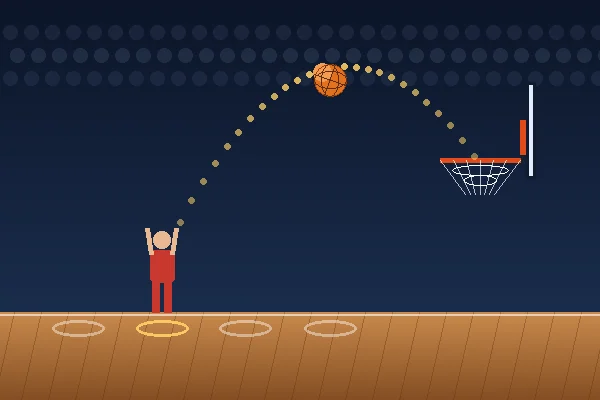
On paper, the free throw is the easiest basketball game anyone could build. Fixed distance. No defender. No clock. One input.
In practice it is one of the hardest things in the genre to make worth playing, and understanding why explains a lot about arcade design generally.
Before going further, one thing plainly: this site does not host a dedicated free throw game. This article explains what such a game has to solve, and points you at the closest equivalents we do have. We would rather do that than put a "Free Throw Game" heading on something that is not one.
The fixed-answer problem
Every shooting game is a function: you provide an input, the physics produce an outcome. In a game with varying distance, the correct input changes constantly, so you are exercising judgement on every shot.
A free throw fixes the distance. That means there is exactly one correct input, forever. Find it, and the game stops being a judgement test and becomes a repetition test — can you reproduce the same number over and over?
Repetition tests are not inherently bad. They are just a different, thinner kind of game, and without something else in the loop they run out quickly.
What good free throw games add
Designers solve this in three ways, and only three are any good.
Pressure. Add a clock, a crowd, a consequence. The input stays the same but executing it gets harder because you are hurried. This is honest: the skill being tested is composure, and composure is a real skill.
Decay. Make the game take something away over time — a shrinking window, a narrowing rim, a combo that expires. The correct answer is still one number, but the tolerance around it keeps tightening. This is the most elegant solution because it scales naturally.
Variation that you can read. Move the shooter slightly, tilt the rim, add a visible crosswind. The key word is visible: the player must be able to see the change and respond to it. Then it is still a judgement game, just with a new variable.
What bad free throw games add
Invisible random deviation. The most common mistake in the genre. The game applies a hidden random offset to your shot, so a correct input sometimes misses.
This feels like difficulty and is actually the removal of agency. The player can no longer diagnose a miss, which breaks the feedback loop that makes arcade games satisfying. A game where you cannot tell whether you were wrong or unlucky teaches nothing.
The tell is simple: if you shoot identically twice and get different results with no visible cause, the game is rolling dice at you.
Excessive ceremony. Long animations between shots, mandatory dribbling sequences, unskippable celebration. In a game whose core loop is seconds long, anything that pads the loop is hostile.
The closest equivalents here
If free-throw-style shooting is what you want to practise, two games on this site use the same mechanic.
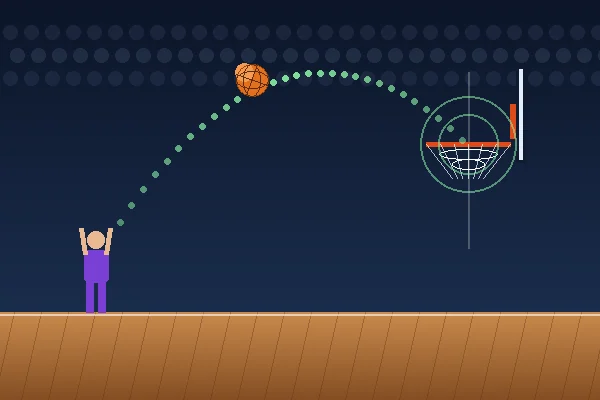
3-Point Basketball Challenge — the fixed-angle, variable-power shot at the heart of a free throw game. The nearest spots in each rack are the shortest shots available on the site, and the scoring rewards exactly the consistency a free throw game would test.
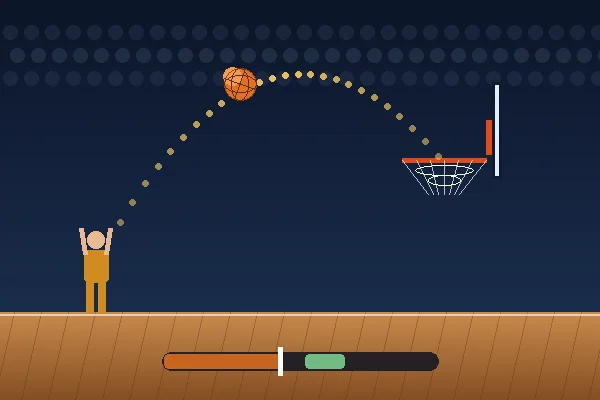
Basketball Time Attack — the same fixed-angle shot with a hold-and-release charge and a green window drawn for the current distance. The short-range shots here are functionally free throws with a visible tolerance.
Neither is a free throw game, but both exercise the identical skill: reproduce a known input accurately, under pressure, repeatedly.
How to practise consistency
Consistency is a different thing from accuracy, and it is measured differently.
Accuracy is your percentage. Consistency is how tightly your attempts cluster — whether your misses are all narrowly long or scattered in every direction.
To measure it:
- Pick a fixed-angle game and stay at one distance as much as the game allows.
- Take twenty shots without adjusting anything, even after a miss.
- Note not just how many went in, but whether the misses shared a direction.
Misses all in one direction means your input is consistent but miscalibrated — easy to fix, one adjustment.
Misses scattered means your input itself is varying — which is the actual free-throw problem, and it is fixed by rhythm rather than by aiming. Release on a count instead of on a feeling.
What a real free throw has that a game does not
Worth spelling out, because it explains the design problem precisely.
A real free throw is difficult for reasons that mostly cannot be modelled as a player input: fatigue, crowd noise, the pressure of the situation, the accumulated micro-variation of a human body repeating a motion. The physical task is identical every time; everything that makes it hard is internal.
An arcade game has none of that. The "body" executing the shot is a function, and a function repeating the same input produces the same output. So the difficulty has to be re-created somewhere else, and the designer has exactly three honest places to put it:
- In the input — make producing the correct value hard, via a meter or a narrow window.
- In the situation — vary the conditions between shots.
- In the stakes — make failure cost something.
Anything else — notably, randomising the outcome of a correct input — is simulating the feeling of missing a free throw by removing the player's agency. It produces the right emotion and destroys the feedback loop.
Three designs that would work
Concretely, what a good free throw game could be.
The shrinking tolerance. Every make narrows the window slightly. The run ends when you can no longer hold it. Difficulty is entirely visible, the answer stays the same, and the game becomes a test of how long you can hold a decaying standard. This is the design we would build.
The interference game. Visual or timing interference is introduced progressively — the meter speeds up, a distraction crosses the screen, the bar becomes harder to read. Crucially, the interference is visible, so the player can adapt. This is the closest honest analogue to crowd pressure.
The streak ladder. A fixed, generous window, but the score is exponential in streak length and resets completely on a miss. Easy to make one; agonising to make fifteen. Difficulty comes entirely from the stakes rather than from the task.
All three keep the central property: a correct input always works.
The consistency test
Free-throw-style shooting measures something distinct from accuracy, and it is worth measuring separately.
Accuracy is your percentage. Consistency is how tightly your attempts cluster.
Take twenty shots at the same distance without adjusting anything, even after a miss. Then answer one question: did your misses share a direction?
- All one way — your input is consistent, your calibration is off. One adjustment fixes it.
- Scattered — your input itself is varying. This is the real free-throw problem, and aiming
harder does not fix it.
For the second case, the fix is rhythm rather than aim. Count to a beat and release on the same count every time. Most players see their scatter tighten noticeably within twenty shots, because the variation was coming from releasing on a judgement rather than on a schedule.
Where to practise it here
Since we do not host a dedicated free throw game, the nearest equivalents:
3-Point Basketball Challenge — stay conscious of the nearest spot in each rack. It is the shortest shot on the site and uses the same fixed-angle, variable-power mechanic a free throw game would.
Basketball Time Attack — the short-range shots are functionally free throws with a visible tolerance, and the hold-and-release input makes the rhythm requirement explicit.
Neither is the thing. Both exercise the skill.
If we build one
A dedicated free throw game on this site would need to solve the fixed-answer problem honestly. The version we would build uses decay: the tolerance narrows with every make, so a run ends not when you fail a fixed test but when you can no longer hold a shrinking one. No hidden randomness, and the current tolerance drawn on screen the way the windows in our other games are.
That is not a promise with a date attached — it is what the design would have to be to be worth playing. If it ships, it will appear in the shooting games category.
Frequently asked questions
Does Basketball Arcade have a free throw game?
Not a dedicated one. The nearest equivalents are the closer spots in the 3-Point Basketball Challenge and the short-range shots in Basketball Time Attack, both of which use the same fixed-angle, variable-power mechanic a free throw game would.
Why are free throw games often boring?
Because a fixed distance has exactly one correct input, so once you find it the game becomes repetition rather than judgement. Designers have to add something — pressure, variation or decay — to keep a decision in the loop.
What makes a free throw game good?
Something that changes between shots without making the outcome random. A decaying combo, a shrinking timing window, or a scoring system that pays for precision rather than mere success all work. Random deviation applied to the ball does not.
How do I practise free-throw-style consistency?
Play a fixed-angle game and focus on repeating the same release rather than on scoring. The skill is reproducing an input, which is best measured over three full rounds rather than within one.