Basketball Challenge Games
The Best Basketball Games for Short Sessions
What makes a game genuinely short-session friendly — and which of ours fit a two-minute gap without leaving you mid-thought.
Most "quick games" lists rank by round length. That is the wrong metric. A thirty-second round in a game that takes ninety seconds to load, explain itself and start is not a quick game.
What actually matters is the whole loop: open, understand, play, stop. Any friction in any of those four steps costs more than a longer round does.
The four things that make a game short-session friendly
1. It starts fast. Page load to first input. Every game on this site is a single HTML page with no frameworks, no asset downloads and no loading screen — the court is drawn from code the moment the page is ready.
2. It needs no re-learning. If you played it last week and have to re-read the controls, the session is over before it starts. One-button games win here by default.
3. Stopping costs nothing. No save file to protect, no progression to interrupt, no penalty for closing the tab. You can walk away mid-run and the only thing lost is that run.
4. It does not escalate across sessions. Games that expect you to build up over many runs are hostile to short sessions, because you never get past the early stages.
The ranking, by how little time you have
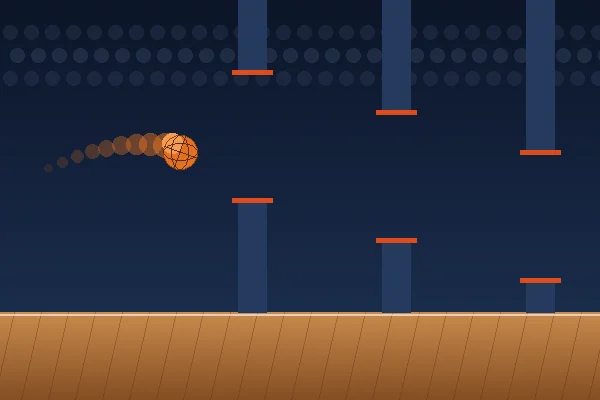
Under two minutes: Basketball Hoop Rush
One button. The rule is "tap to bounce, go through the hoops", which takes about four words to explain and zero seconds to remember. Early runs last thirty to sixty seconds, so a two-minute gap fits two or three complete attempts.
It also works in portrait with one hand, which no other game here does as comfortably.
Two to five minutes: Basketball Precision Shot
Play Basketball Precision Shot
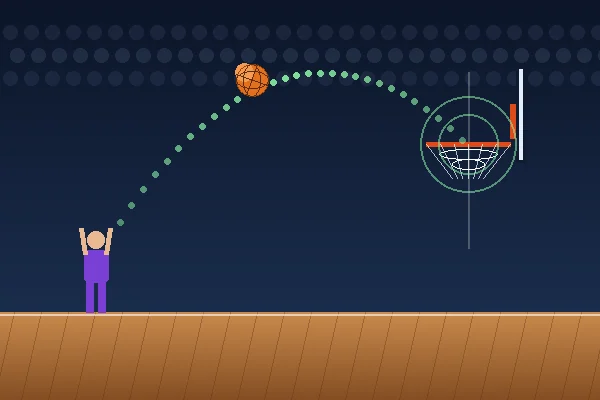
One button, no clock, five misses. A run lasts as long as you are playing well, which early on is one to three minutes.
The absence of a clock is what makes it good here specifically: you can stop thinking about it at any point without a countdown nagging at you.
Exactly one minute: Basketball Time Attack
Sixty seconds, by design. The most predictable option on this page — you know exactly how long it will take before you start, which matters when the gap is a fixed one.
The trade-off is intensity. The combo decays if you stall, so it is the least relaxing game here. Good for a deliberate break, less good for a distracted one.
Exactly one minute, calmer: 3-Point Basketball Challenge
Play the 3-Point Basketball Challenge
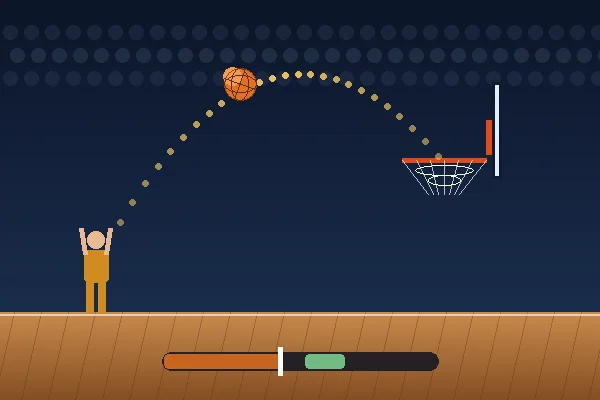
Also sixty seconds, but paced by the meter rather than by you. It feels slower even though it is the same length, because the rhythm is set for you.
Short but escalating: Dunk Challenge
Runs are short — three misses come quickly — but the interesting part of the game is round eight onwards, which takes a few minutes to reach. Better when you have five minutes than two.
The one to skip when rushed: Basketball Shooting Challenge
Play Basketball Shooting Challenge
It is sixty seconds like the others, but drag aiming rewards settling in, and the first fifteen seconds of any session are usually recalibration. Excellent with twenty minutes; slightly wasted on two.
Quick comparison
| Game | Typical run | Controls | Best gap |
|---|---|---|---|
| Hoop Rush | 30–60s | One button | Under 2 min |
| Precision Shot | 1–3 min | One button | 2–5 min |
| Time Attack | 60s exactly | Hold and release | Exactly 1 min |
| 3-Point Challenge | 60s exactly | One button | Exactly 1 min |
| Dunk Challenge | 1–4 min | One button + run | 5 min |
| Shooting Challenge | 60s exactly | Drag to aim | 20 min |
Practical notes for breaks
Sound is optional. Every game has a mute toggle above the court and remembers your choice. The audio is useful feedback but never the only signal for anything.
Tab switching pauses automatically. If someone appears at your desk, switching away pauses the game rather than running your clock down.
Home screen shortcut. On a phone, saving the games page to your home screen removes the browser chrome and a couple of taps. It is a browser bookmark feature, not an app install — nothing downloads.
Nothing is lost by leaving. Your best scores are already stored; an abandoned run simply does not count.
The arithmetic of the restart loop
Why round length matters less than people think.
Suppose a game has a thirty-second round and takes eight seconds between one run ending and the next beginning — an interstitial, an animation, a menu. In a five-minute session, you get roughly eight attempts, and about a fifth of your time is spent not playing.
Now take a sixty-second round with a one-second restart. Same five minutes, five attempts, and nearly all of your time is spent playing.
The second game feels far better despite having fewer rounds, because the thing you are actually optimising in a short session is time-in-play, not attempt count.
This is why the restart loop is the single most important property for short-session play, and why every game here restarts on the key that was already under your finger.
Short sessions and actually improving
A common assumption is that short sessions are for fun and long sessions are for improvement. The evidence from these games suggests close to the opposite.
Timing accuracy degrades noticeably after about twenty to twenty-five minutes. Past that point you are practising a worse version of your own play, and the habits you reinforce are the tired ones.
Two fifteen-minute sessions on separate days reliably beat one thirty-minute session, and both beat an hour. The spacing matters more than the total.
So the short-session games are not a compromise. Structured properly — one game, one thing to watch, a number written down — a five-minute session is a complete practice unit.
Choosing by what you want from the break
The other axis nobody lists.
You want to stop thinking about work. Pick something demanding enough to occupy you fully. Basketball Time Attack or Basketball Hoop Rush — the pace leaves no room for anything else.
You want to calm down. Pick something with no clock. Basketball Precision Shot is the only game here where nothing is hurrying you, and the difference in how a break feels is substantial.
You want a sense of progress. Pick something you have played before and know your number for. Beating a personal best by a small margin is a better five minutes than a novel game you will score badly at.
You want to not think at all. Hoop Rush. One button, pure rhythm, no decisions beyond up or not up.
What makes a game bad for short sessions
The inverse list, useful for evaluating anything you find elsewhere.
Anything that escalates across runs rather than within them. If the interesting part of a game is at minute ten, a two-minute session never reaches it.
Unskippable anything. Splash screens, tutorials on every load, celebration animations.
Progress that can be lost. A game that punishes you for stopping is a game that will make you feel bad about a break.
A load time you notice. More than a second or two and the calculation changes entirely.
Sound required. In a lot of short-session contexts — an office, a waiting room, a train — audio is not an option. A game where sound carries information you cannot get visually is unplayable there.
A note on what this list is not
These recommendations come from playing the games, not from usage data — we do not track how long anyone plays. The run lengths above are typical for a player in their first few sessions, and they get longer as you get better, which is the point.
More on phone-specific setup in how to play basketball games on mobile.
Frequently asked questions
What makes a game good for short sessions?
A fast start, a short loop, and no cost to stopping. Round length matters less than how quickly you can get from opening the page to playing, and whether quitting mid-run loses anything.
Which basketball game is quickest to pick up?
Basketball Hoop Rush. One button, no instructions needed beyond "tap to bounce", and the first run starts about two seconds after the page loads.
Can I stop mid-game without losing my score?
Your best score is already saved from previous runs. The current run’s score is only recorded when the run ends, so leaving mid-run means that run does not count — but nothing previously earned is lost.
Are these games good on a work break?
They are built for it: no download, no account, no sound required, and a round under two minutes. Every game pauses automatically if you switch tabs.