Basketball Skill Games
Basketball Skill Games for Beginners: Where Precision Is the Point
Why the category that sounds hardest is actually the best place to start, and how accuracy grading rewires the way you play.

"Skill game" sounds like the advanced category. It is actually the best place to start, and the reason is a design property the name does not convey: skill games usually show you what correct looks like before they ask you to produce it.
The defining feature: graded success
In most arcade games a shot either counts or does not. In a skill game, how well it counted is the score.
Basketball Precision Shot is the clearest example. Every make is graded on how centrally the ball passed through the rim:
- Perfect — near dead centre — 15 points
- Great — comfortably inside — 10 points
- Good — clipped the edge but dropped — 6 points
All three count as makes. Only one is worth full value.
This changes what you learn. In a pass/fail game, a shot that barely scrapes in feels identical to a clean one, so you never find out that your aim is drifting. In a graded game, the drift is visible in the score before it becomes a miss — which is feedback arriving early enough to act on.
Why this suits beginners
Three reasons, and none of them is that the games are easy.
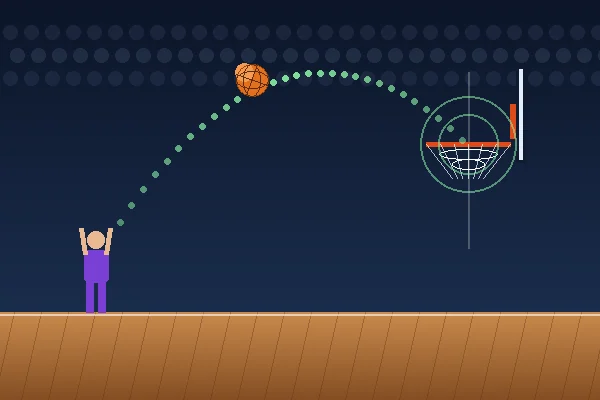
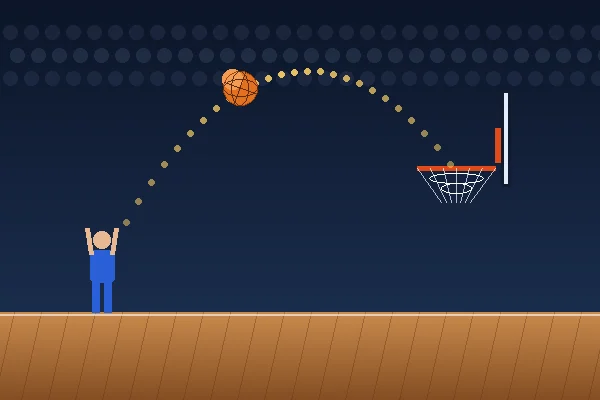
You can see the correct answer. Precision Shot draws the ball's full flight path before you release. You are not inferring physics from failures; you are reading a line. The game teaches itself.
There is no clock. Five misses ends the run and, until you spend them, time is free. Nothing punishes you for taking a moment to think, which is exactly the condition under which people learn fastest.
Failure is legible. When you miss, you can see whether the arc was wrong or the hoop had moved. Two different problems with two different fixes, and the game distinguishes them for you.
The habit that separates beginners from good players
Here is the thing almost nobody discovers unprompted.
The hoop in Precision Shot drifts up and down on a sine path. That means it spends most of its time moving — but at the very top and the very bottom of its travel it is briefly almost stationary.
Those two moments are dramatically easier than any other, and waiting for them costs nothing, because there is no clock.
Most beginners never wait. They shoot on a rhythm carried over from timed games, spend their five lives on shots they did not need to take, and conclude the game is hard.
Try one round where you only release when the hoop is at the top or bottom of its travel. Scores typically double. It is the single highest-value tactic in the game.
Combo multipliers make consistency king
Skill games usually pair accuracy grading with a combo multiplier, and the combination is what gives the category its ceiling.
In Precision Shot the multiplier rises every two consecutive makes and caps at x5. So a Perfect at full multiplier is worth 75 points where a Good shot cold is worth 6 — a factor of more than twelve between your best shot and your worst made shot.
The strategic consequence is immediate: once your multiplier is high, the value of any individual shot is at its peak, which is precisely when a risky attempt costs the most. Protect it.
This is the same arithmetic covered in how to get higher scores, but it bites hardest here because the base values are graded too.
Other games in this category
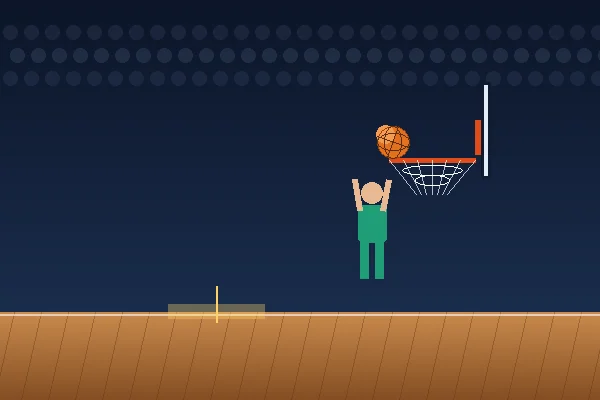
Basketball Shooting Challenge is a shooting game with a skill-game reward layer: a bonus point for any shot that goes through without touching the rim, on top of the streak multiplier. That makes clean shooting worth pursuing rather than merely satisfying.
Dunk Challenge grades finishes as dunk or layup, which is the same idea expressed as two tiers rather than three.
A twenty-minute starter routine
- Minutes 0–5. Precision Shot, playing normally. Note your score.
- Minutes 5–10. Precision Shot, releasing only at the top or bottom of the hoop's travel.
Compare.
- Minutes 10–15. Precision Shot, trying to reach a x5 multiplier at least once, taking no risks
to get there.
- Minutes 15–20. Whichever of the three approaches scored highest, repeated.
That last round is usually the patient one, and finding that out for yourself is worth more than being told.
How graded scoring changes practice
The practical effect of accuracy grading is that it gives you a signal before you start failing.
In a pass/fail game, your feedback is binary. You can be slowly drifting off-centre for twenty shots and see no difference at all — until the drift crosses the edge of the rim and you suddenly start missing. By the time you notice, you have been practising the drift.
In a graded game, that drift shows up immediately as your scores sliding from Perfect to Great to Good. The information arrives while the shots are still going in, which is exactly when it is most useful and least costly.
This is why skill games are better for improvement than their reputation suggests. They are not harder versions of shooting games; they are shooting games with better instrumentation.
A measurement routine
Twenty minutes that will tell you whether you are actually improving.
Round 1 — baseline. Play Basketball Precision Shot normally. Note two numbers: your score, and roughly what fraction of your makes were graded Perfect.
Round 2 — patience. Release only when the hoop is at the top or bottom of its travel. Note the same two numbers.
Round 3 — combo focus. Take no shot you are not confident in, even if that means waiting several seconds. Note the longest combo you reached.
Round 4 — repeat your best approach.
The comparison between rounds 1 and 2 usually shows the largest single gap most players have. The comparison between the Perfect fraction across rounds tells you whether your aim is improving independently of your patience — which is the thing raw score cannot separate.
Why the combo cap matters
A detail that changes strategy once you notice it.
The multiplier in Precision Shot caps at x5, reached after eight consecutive makes. That has a specific consequence: past eight makes, additional consecutive makes add nothing to the multiplier. They only add their own points.
So the value of a long streak is front-loaded. Getting from x1 to x5 is enormously valuable; staying at x5 is worth exactly the base value of each shot.
What this implies:
- Early in a streak, be extremely conservative. You are protecting the climb, which is worth far
more than any individual shot.
- At the cap, you can afford slightly more risk — a miss still costs the whole multiplier, but
you are no longer building anything by being cautious.
- A miss at x1 costs almost nothing. If you are going to take a difficult shot, that is the
moment.
Most players play this backwards: cautious when the multiplier is already capped, loose while building it.
Skill games and the patience habit
The genuinely transferable thing this category teaches is not aim. It is recognising which opportunities are cheap and waiting for them.
That habit shows up everywhere:
- In Dunk Challenge, it is taking the layup instead of gambling on
the dunk.
- In Basketball Hoop Rush, it is skipping the centring bonus
when the approach is awkward.
- In Basketball Time Attack, it is the one situation where
the habit is wrong, because the combo decays on a timer.
That last exception is worth knowing. Patience is a strategy, not a virtue — it pays when waiting is free and costs when it is not.
Where to go next
- Basketball Precision Shot — the game above.
- All skill games — the category.
- A beginner's starting guide — a structured
first session across the whole site.
Frequently asked questions
What is a basketball skill game?
One where the scoring rewards precision rather than volume — landing closer to the centre of the target, or repeating a good input consistently, is worth more than simply succeeding.
Why are skill games good for beginners?
Because they usually show you what a correct input looks like before asking you to produce one, and because they rarely put you under a clock while you are still learning.
What does accuracy grading mean?
The game scores the quality of a success, not just its occurrence. Basketball Precision Shot pays fifteen, ten or six points depending on how centrally the ball passed through the rim.
How do I improve at precision games?
Wait for easier opportunities. In games with a moving target and no clock, waiting is free, and most beginners shoot on a rhythm inherited from timed games instead of picking their moment.