Basketball Arcade Guides
The Best Basketball Arcade Games to Play Online Right Now
Six games compared by what each is genuinely good for, plus how to judge a basketball arcade game you find anywhere else.

Every "best games" list has the same problem: best at what? A game that is perfect for ten minutes of focused practice is a bad choice for two minutes in a queue, and the game that teaches you most is rarely the one that is most fun on a first try.
So this is not a ranking. It is six games, each matched to the situation it actually suits, followed by a short method for judging any basketball arcade game you find elsewhere.
One note on scope, because it matters for trust: we only write about games we have played extensively, and right now that is the six built for this site. We do not publish ratings for games we have not put real hours into, and we do not collect user reviews, so you will not find a score out of ten anywhere on this page.
If you have never played one before
Basketball Precision Shot
Play Basketball Precision Shot
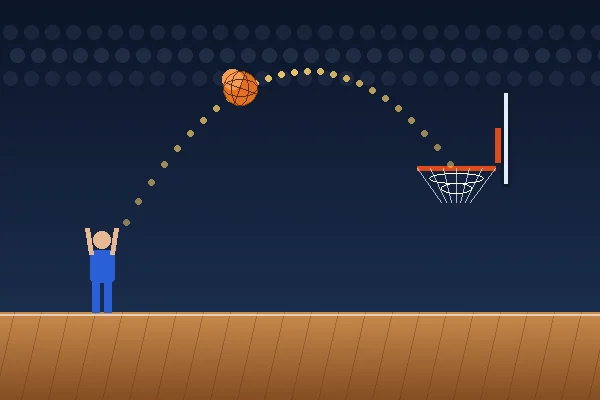
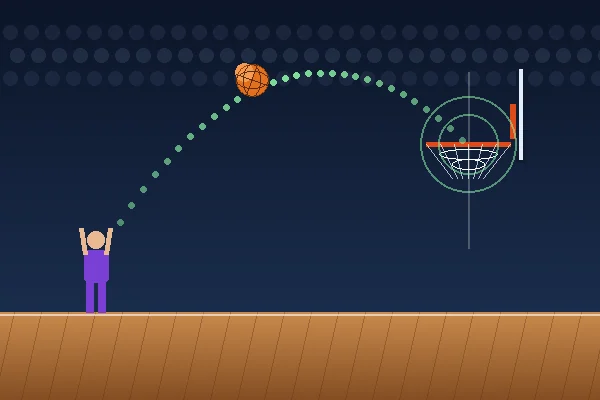
The release angle sweeps up and down on its own, and a dotted line shows exactly where the ball will go. Press when the line meets the hoop.
That design decision — showing the answer — is why this is the right first game. Most arcade shooting games ask you to infer physics from failures. This one lets you see the correct shot before you take it, which turns a guessing game into a timing game.
There is no clock. Five misses ends the run, and until you spend them, waiting costs nothing. That combination is unusually forgiving for the genre.
Best for: first-time players, anyone who wants to understand arc, and quiet play without time pressure.
Less good for: players who want pressure. There isn't any until quite late.
If you want to actually improve
Basketball Shooting Challenge
Play Basketball Shooting Challenge
The only game here that hands you both variables. Drag from the shooter to set angle and power, release to shoot, and do it again from a different distance because the rim relocates after every attempt.
That relocation is the point. It makes memorising a single input useless and forces you to build actual distance judgement, which is the skill that transfers to every other game in the genre.
The streak system rewards it too: a multiplier that climbs every three makes to a cap of x4, plus a bonus point for any shot that goes through without touching the rim.
Best for: deliberate practice, players who want control, anyone working through our accuracy guide.
Less good for: phones in portrait. Drag aiming wants a wider screen.
If you want pressure
3-Point Basketball Challenge
Play the 3-Point Basketball Challenge
Five shooting spots at five distances, five balls at each, sixty seconds. The release angle is fixed at 56 degrees, so power is the only variable — and because every spot is a different distance, the correct power changes every time you move.
This is the hardest game on the site and the most satisfying to get good at. The moment it clicks is when you stop watching the needle and start shooting on a rhythm.
The last ball of each rack is worth an extra point, and a streak of three or more adds another on every make, so a clean rack compounds quickly.
Best for: players who like a clock, and anyone who enjoys learning a meter.
Less good for: a first session. It is genuinely difficult cold.
Basketball Time Attack
Sixty seconds, hold to charge, release inside the green band. The band is not decoration — it is calculated from the flight maths for the current distance, so if you release inside it the ball goes in.
The distinguishing feature is the combo clock. Your multiplier expires 3.6 seconds after your last make, which means hesitation is scored against you directly rather than merely wasting time. It is the most relentless game here.
Best for: players who want a score to chase and do not mind being hurried.
Less good for: learning. The pace punishes the experimentation that teaches you things.
If you want rhythm rather than aiming
Dunk Challenge
Your player runs at the rim automatically. The jump is a fixed arc. You choose one thing: when it starts.
What lifts it above a pure timing test is the run control. Braking and sprinting change both where the take-off band sits and how wide it is — sprinting gives you a bigger target but less time to react to it. That is a genuine strategic choice rather than a difficulty slider.
Three misses ends the run, and every cleared round runs faster with a tighter window.
Best for: players who prefer rhythm to aiming, and short competitive sessions.
Less good for: anyone who dislikes losing a run to a single mistimed press.
Basketball Hoop Rush
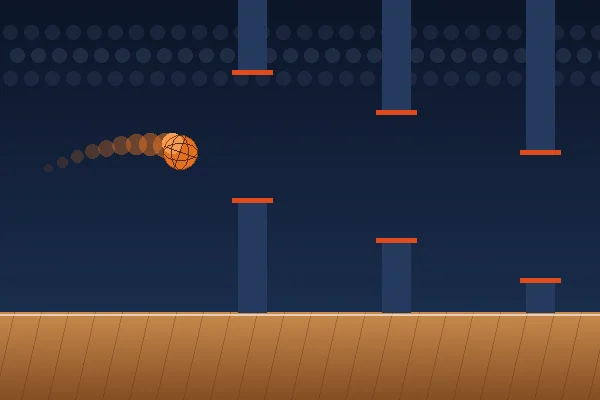
The endless one. The ball falls constantly, each tap bounces it, and hoops scroll past faster and narrower the longer you last. Past twenty of them some start drifting vertically.
It is the least basketball-like game on the site and the most immediately playable. Ten seconds to understand, one button, works one-handed in portrait.
Best for: phones, short breaks, and anyone who wants a personal best to nudge.
Less good for: practising shooting. It teaches a different skill entirely.
Choosing quickly
| Situation | Game |
|---|---|
| First time playing anything like this | Basketball Precision Shot |
| Two minutes on a phone | Basketball Hoop Rush |
| Twenty minutes of real practice | Basketball Shooting Challenge |
| Want a clock and a challenge | 3-Point Basketball Challenge |
| Want something relentless | Basketball Time Attack |
| Want rhythm, not aiming | Dunk Challenge |
How to judge a basketball arcade game anywhere else
The genre is full of games, and most of the signals people use to pick one are noise. Download counts measure marketing. Star ratings measure how many people were annoyed enough to leave one.
Here is a better method, and it takes about a minute.
Play thirty seconds. Can you tell why you missed? This is the single best test. A good arcade game makes failure legible — you missed long, you jumped early, you were off-centre. A bad one just says "no". If you cannot diagnose a miss, you cannot improve, and the game will feel random regardless of how it looks.
Does it explain its scoring? Games that hide the scoring rules usually have rules that would disappoint you. A game confident in its design tells you what a combo is worth.
Does difficulty rise for a reason you can see? Good games show you what changed — the rim moved, the meter sped up, the window narrowed. Bad ones just get harder invisibly, which feels like the game cheating.
Does it work on your phone without fighting you? Touch targets that are too small, a playfield that scrolls when you swipe, controls hidden behind the fold. These are quick to spot and rarely get fixed.
Is it asking for something before you play? A browser game that wants an account before the first round is selling something other than the game.
All six, side by side
The comparison most people actually want, in one place.
| Game | Control | Round | Ends on | Difficulty | Best for |
|---|---|---|---|---|---|
| Precision Shot | One tap | 1–3 min | 5 misses | Easy to learn | Learning arc, calm play |
| Hoop Rush | One tap | 30–60s | Any collision | Medium | Phones, quick breaks |
| Dunk Challenge | Tap + hold | 1–4 min | 3 misses | Medium | Rhythm and timing |
| Shooting Challenge | Drag to aim | 60s | Clock | Medium | Deliberate practice |
| 3-Point Challenge | One tap | 60s | Clock | Hard | Distance judgement |
| Time Attack | Hold, release | 60s | Clock | Hard | Pressure, high scores |
Two patterns are worth noticing. The one-tap games are not the easy ones — Precision Shot is the gentlest game here and the 3-Point Challenge is the hardest, and both use a single input. And the games that end on a clock are all harder than the games that end on a life count, because a clock removes the option to wait.
What is missing, and what we would build next
An honest list of gaps rather than a roadmap with dates attached.
Local two-player. Two sets of controls, one screen, one round. This is the most obvious gap and the most realistic thing to add, because it needs no servers. Right now the multiplayer category describes pass-the-device formats instead of listing games, which is the honest version of not having it.
A free throw game that works. A fixed distance has one correct answer, which makes it a repetition test rather than a judgement test. The design that would solve it is a shrinking tolerance rather than hidden randomness — the longer argument is here.
A dribbling or ball-control game. The skill-games category is currently one game wearing two hats. A genuine ball-control mechanic would give it something distinct.
Something with a longer arc than sixty seconds. Everything here is a sprint. A five-minute format with a structure — rounds, escalating conditions, a comeback mechanic — would sit differently.
None of these is promised. They are what we would build if we build anything, and this section exists so that "coming soon" never appears on a category page.
What we do not list, and why
A few categories of game are deliberately absent from this site.
Games we did not build. We only write in depth about games we have played extensively, and hosting someone else's game raises licensing questions we would rather not guess at. A short list we can stand behind beats a long one we cannot.
Anything using real teams, players or logos. Not because those games are bad, but because using that material needs rights we do not have. Everything here is original artwork drawn in code.
Games that gate the first round. A browser game that wants an account before you play is selling something other than the game.
Games with hidden randomness. If identical inputs produce different outcomes with no visible cause, the game cannot be learned, and everything we write about improvement stops applying.
Where to go next
- The full game directory, filterable by type, difficulty and control scheme.
- How basketball arcade games work if you want
to understand the systems underneath.
- A beginner’s starting guide for a structured
first twenty minutes.
Frequently asked questions
What is the best basketball arcade game for beginners?
Basketball Precision Shot, because it draws the ball’s full flight path before you release. You can see what a correct shot looks like rather than inferring it from failures, and there is no clock to rush you.
Which basketball game is best for a short break?
Basketball Hoop Rush. It starts instantly, a run lasts under a minute early on, and it needs one button, so it works on a phone with one hand.
Are there free basketball games that work without downloading anything?
Yes — every game on this site runs directly in the browser with no download, no plugin and no account. That is the normal arrangement for HTML5 games.
How do you decide which basketball game is best?
We do not rank games we have not played extensively, and we do not publish star ratings because we do not collect user reviews. What this article does instead is describe what each game is genuinely good at, so you can match one to what you want right now.